Decoding Gen Z Lingo

For once, a person might plan and execute a flawless heist and even manage to escape after being caught, but decoding Gen Z slangs can trouble you far more than any jailbreak. You could search online to satisfy your curiosity, but in everyday conversations, you might fail the “vibe check” and end up being called a “normie”. Understanding Gen Z vocabulary is no longer just a bonus skill, it has become the bare minimum to blend into the culture that surrounds young people today
You may have walked into a café and overheard a group of teenagers or young adults talking in a way that sounded like encrypted messages. They weren’t, of course—it was simply Gen Z conversation. Their speech combines words, phrases and abbreviations in a style, complex enough to make even Google Translate hesitate. And, these expressions spread most quickly through social media, where captions, comments and trends, constantly create and redefine vocabulary.
Gen Z slang in everyday conversation
Take the word “FOMO”, short for “Fear of Missing Out". You’ve likely experienced it at some point—maybe when your friends planned a weekend trip and you were dragged to a family function you had no interest in attending. The feeling is universal; the term is just the Gen Z way of describing it. Another example is getting caught sneaking a pastry from the refrigerator at midnight. Your sibling snaps a picture of you as proof. In Gen Z terms, you were “caught in 4K", meaning you were busted with undeniable evidence.
In a typical Gen Z conversation, “bro” is used more often than the actual name, regardless of gender. It can refer to the person you’re talking to or someone else entirely. For instance: “Bro, I studied all night and still failed the exam", or “I warned him about the hot pan and bro grabbed it anyway". The term has become a casual greeting and a default way of addressing others. Many such words have become informal customs of daily communication.
When someone shows off possessions or skills, Gen Z calls it “flexing". Similarly, if a person performs exceptionally well, they are said to have “ate”. You could tell a friend, “You posted one picture and the likes exploded— you ate". Furthermore, “cooked” refers to something broken or chaotic, often used in a humorous or critical way. You might hear it in everyday situations, like after failing an exam and realising you studied the wrong chapter— “Yeah, I’m cooked".
The list goes on. Imagine someone claiming they’re over their ex. If their friends respond, “Cap, you still stalk their stories", they’re calling that statement a lie. “Cap” means falsehood, while “no cap” means the opposite—honesty. “Bet” is another popular expression. It can function as an affirmation or a challenge. If someone says they’ll meet you at eight and you reply, “Bet", it means you agree and accept. When something feels special in a way that is difficult to explain, it “hits different”. A familiar song at 2 a.m., old photos, or even a childhood meal might hit different because it connects with memory, mood or nostalgia. There is also “brainrot", a term that reflects modern media habits. When a song, video, idea or celebrity occupies your thoughts so intensely that you cannot escape it, you are experiencing brainrot.
"These words might amuse you, surprise you, or even feel awkward at first, but they reflect how Gen Z communicates on a daily basis"
Dating, love and modern relationships
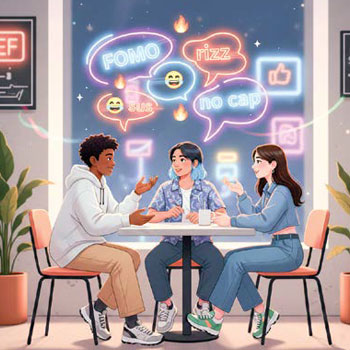
Gen Z’s dynamic dating culture has brought its own set of vocabulary. “Red flag” is probably the most fundamental term. It refers to warning signs—traits or behaviours that may be toxic or problematic in a relationship. Its opposite, “green flag”, signals positive qualities or emotional safety. If someone calls a person a “snack”, they’re referring to them as physically attractive. Then comes “rizz”, short for charisma. It describes someone’s ability to flirt or charm. In practice, it sounds like: “No rizz today, bro; I fumbled every conversation".
“Situationship” is another modern dating term, which is used when two people act like they’re in a relationship—sharing affection, dates or emotional intimacy—but refuse to label it or define where it is going. It exists somewhere between friends and partners, often leaving both sides confused or unsure of expectations. Similarly, “breadcrumbing” describes giving someone just enough attention to keep them interested, without committing to anything real. This often involves vague messages and mixed signals. On the other hand, “love bombing” is when someone floods you with affection, gifts and compliments, in order to manipulate or rush you into a relationship.
We also have “ghosting”, used mostly in early stages of relationships or friendships. If someone suddenly stops responding to messages or disappears without explanation, they’ve “ghosted” the other person. “Simp” is another such infamous term, referring to someone who goes too far to impress a person they’re attracted to. The sacrifice can be so intense that it appears embarrassing. For example: “He bought her dinner, flowers and a hoodie after just one date— bro’s a simp".
Shortcuts and abbreviations
Abbreviations form a large portion of Gen Z texting language. “Fr” means “for real", and it shows strong agreement or emphasis. “IYKYK” stands for “If you know, you know", and it signals that a reference is exclusive to certain people who understand the deeper meaning. “GOAT” stands for “Greatest Of All Time". It is used when someone is exceptionally skilled or talented. For example: “That teacher is the GOAT—one lecture and everything makes sense". You will often hear it verbally, too. Another commonly used abbreviation is “tbh", short for “to be honest", which adds honesty or vulnerability to a statement— “tbh, I didn’t like that movie". Then there’s “hyd”, meaning “how you doing", a casual conversational opener usually sent at the start of a chat or when reconnecting with someone after a while.
Beyond abbreviations, some slang words don’t even resemble standard spelling. “Delulu” refers to someone who is delusional about a situation or person. “Smol” describes something tiny and cute. You might say, “Look at that smol puppy—he can barely walk". “Finna” is used in place of “about to” or “going to", as in, “I’m finna be late if this bus doesn’t move". Meanwhile, “sus” is short for suspicious and is used when something or someone seems shady or untrustworthy— “He said he wasn’t at the party, but everyone saw him there… kinda sus". These expressions may seem unconventional, but their charm lies in their simplicity and sound.
You might also be labelled based on the energy you give off. Someone who behaves awkwardly, repeats the same ideas, or lacks individuality may be jokingly called an “NPC”—a non-player character, referring to the background characters in video games. On the contrary, you could be praised as a “main character” or said to have “main character energy". This label is meant for confident and expressive individuals who move through life as if they are the protagonist of a story.
The connection behind the slang
It is often said that when you travel far from your home country and unexpectedly meet someone who speaks your native language, it “hits different". The sense of familiarity allows you to open up more easily. Understanding Gen Z vocabulary works in a similar way. If you plan to hang out with a group of Gen Zs, whether at a coffee shop or a casual gathering, knowing their slang helps you connect with them. These words might amuse you, surprise you, or even feel awkward at first, but they reflect how Gen Z communicates on a daily basis. Their slang doesn’t run short, and it may take more than just one read to fully grasp the rhythm of it. But once you understand the basics, you’ll find yourself decoding conversations that once felt like encrypted messages.