A India’s Telecom Manufacturing Boom: Driving innovation, exports and digital sovereignty
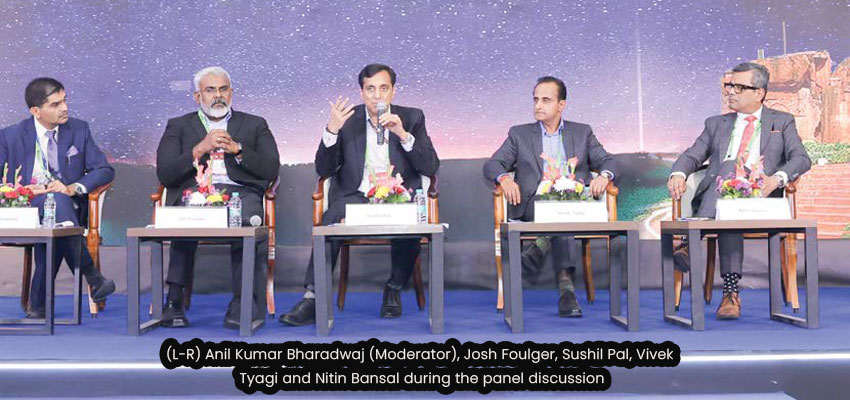
How India's telecom factories are shaping the country's future with innovation, exports, and keeping our digital landscape safe? In a panel discussion held at the recent India Mobile Congress 2025, in New Delhi, experts from across industries conversed about how this evolution is helping to make India a global leader in telecom innovation and manufacturing, exports and digital sovereignty, and what's coming up next. Corporate Citizen brings you excerpts from this riveting discussion
Panellists
- Anil Kumar Bhardwaj (Moderator): DDG SE, Department of Telecommunications, Ministry of Communication & IT, Govt. of India
- Josh Foulger,CEO, Zetwerk Electronics
- Sushil Pal,Joint Secretary, Ministry of Electronics & Information Technology (MeitY)
- Vivek Tyagi: MD – India, Analog Devices
- Nitin Bansal,MD, Country Manager, India & Head-Networks, Market Area Southeast Asia, Oceania and India, Ericsson
Anil Kumar Bhardwaj: India is in a very sweet spot today; we not only have great startups, but we also now have a great startup ecosystem. Our mobile manufacturing industry is growing because we have created that great ecosystem of components. We now also have some of the world's best—in terms of quality—electronic manufacturing and service providers, and many of them are now into making advanced technology which are delivering quality, and delivering within the timeline while meeting the logistics required by the global players. In addition, as part of the government we are willing to invest our energies with these manufacturers. I'm not talking about startups alone; we are willing to invest our energies with companies whom we want to grow. In our role as a policy enabler, we are willing to sit across the table and find the solutions.
Josh Foulger: In the last 11 years the Government of India has passed some fantastic policies starting with the Bills of Lading Act, 2025, with which we have seen tremendous success; and the latest Electronics Component Manufacturing Scheme (ECMS) initiative. These schemes symbolise the progress government has done and the consistency of the policy. The industry has responded well, and has really sort of challenged both the global value chains and Indian value chains. Manufacturers like us who manufacture telecom products and consumer electronic products, are very keen to start manufacturing these products in our factories across India. India is on the right track in its trajectory towards 2030 national vision.
"When it comes to production, we need skilled people for the production, and government initiatives on skill development are rightly filling the requirements for skilled engineers in the country"
— Nitin Bansal
Vivek Tyagi: I come from semiconductor industry—electronic manufacturing has really taken off in India over the last 10 years whether it's mobile phone, telecom equipment or other electronic equipments, which is good news. The next logical step is that we build PCBs here, we build some components here, we build power electronics here, so that we have more value addition when we do local manufacturing. Further, we should emphasise on designing these equipment’s over here, because it adds more value to any equipment that we do. India inherently has a strength in the software, and now it has also developed in manufacturing hardware over the last 10 years. So, the next generation of Production Linked Incentive (PLI) Scheme in my opinion should be a design led manufacturing scheme that emphasises designing in India, sourcing components through local ecosystem that we develop now based on the new ECMS scheme. And, then we actually can say that this is designed, sourced and manufactured equipment in India, for India, and also for the world.
Anil Kumar Bhardwaj (Moderator): Tell us how India's manufacturing is driving innovation?
Nitin Bansal: We realised way back in 1994, that it's important for us to start manufacturing in India. One of the reasons being the customers technology requirements in India are quite advanced. Gone are the days when India was using technology coming from outside. Right now, we can say that anything that can work in India will also work in other parts of the world. When it comes to production, we need skilled people for the production, and government initiatives on skill development are rightly filling the requirements for skilled engineers in the country.
Then it's about components which today are not available. There are great initiatives coming from the government in terms of, the Telecom Manufacturing Zones (TMZs) and Special Economic Zone (SEZs). India is a place to be, it is a place where we need to start—if you have not started yet, you better start now.
Q: Explain us how the ECMS and other initiatives will take our country forward in manufacturing?
Sushil Pal: We have to fire on all cylinders. Design related manufacturing, that's one part of manufacturing and we have already started that for mobile phones, IT hardware and even for telecom as such. So, manufacturing has as a result led to lot of demand for the components. The time is right when we have sufficient demand, sufficient buyers for the components who are ready to consume those things. We need to design our own products, we need to design our own technologies, we need to design our own components, because if you have a control over the designs and the products, you can dictate everything down the line and that's how things work in this electronics industry
The "non-silicon" part of components referred to in the context of the India Semiconductor Mission (ISM), provides fiscal support for setting up manufacturing facilities for these compound semiconductors. You are stating that moving into the "2.0 phase" will involve a greater emphasis on component-level infrastructure and the ecosystem surrounding capital expenditures (CapEx).
When we say digital sovereignty, it means that we become more integrated and be more part of the global value chains than we are as of now. What it does mean that we reduce our reliance on a one geography or one country. The component scheme we launched was again cross sectoral. It caters to the telecom, automotive, electronics, consumer electronics, industrial electronics and everything, because we realise that in this one area you cannot support a company only to cater to one particular product segment, because if you do that then that particular company or beneficiary will never be able to achieve the scale, and the scale is the name of the game here. And, at the same time it has to be manufactured not only to meet the domestic requirements but also to meet the global requirements. For each of the product segment which is covered under the component scheme, we engaged with the players to understand the business, to understand what investment turnover ratio is and which policy instrument would be the right instrument for their support.
Q: What are the boxes which we are able to tick and what are the boxes you feel that we still need to tick, in terms of enabling the industry further, so that we become net supplier of the components to the world?
Josh Foulger: When you look at the ECMS products I would say a lot of them are made in India, and then PLI scheme has embraced that further. Now when you look at the components, we have semiconductor which is now covered in the ECMS 2.0 scheme and that's on a great path right now.
When you look at other elements in our industry, the ECMS scheme covers all of them. All of these are multiple technologies, which require huge capex over a long period of time. Because, these are capex, competencies and capabilities, you have to continue to invest and develop in it. Now this is where India comes in and as a market and as a manufacturer, is what we have seen.
But, India is also going to be a manufacturing hub for countries with which we sign Free Trade Agreements (FTAs). It just makes business sense because manufacturers like us look for the scale involvement. So, a combination of all of these is a great starting point to Make in India and now with ECMS I think we are going to be on a good track. The challenge is, the time it will take for all these things to get qualified. The next three years is a window we need, when we will see a lot of these things coming alive. The beauty is that you are going to see many parts of the country becoming part of the supply chain. So, today you have Chennai, Bengaluru, NCR and other belts. You're going to see Maharashtra coming back, especially a few parts which were not active before. Madhya Pradesh is going to be very active. We will see parts of Andhra Pradesh, Telangana and Karnataka, is going to grow and be more active. We have limitless capability to really transform the supply chain.
Q: In today's era, (Vivek Tyagi) how is Analog Devices looking at the Indian market? Whether it is design, manufacturing or global capacity centres, how are you making things happen and what is the future in India?
Vivek Tyagi: If you look at different markets in India—in car sales we are the third largest market in the world; in telecom equipment we are in the top three markets in the world; for mobilephones we are one of the top two markets—India is a very large market for electronic equipments. Yes there is the right government policy to support manufacturing and design. And, now with component scheme, semiconductor manufacturing scheme and PLI, we have the right policies as well. The rest will follow and there will be capital investment coming from global players. It takes time for the ecosystem to develop.
Historically, India has been a talent bank—so many companies have been doing a lot of global designs out of India, and Analog Devices is no exception. In the last 2-3 decade we have been doing semiconductor chip design, software development, we have a global team here in India working on products and supporting our global customers. As the market is growing our ecosystem is supporting both domestic companies and multinational companies with R&D. We are definitely looking at India as a market and for talent required for doing our global designs.
"India is also going to be a manufacturing hub for countries with which we sign FTAs. It just makes business sense because manufacturers like us look for the scale involvement"
— Josh Foulger
Q: How as a process can we address these inconsistencies of telecom companies?
Nitin Bansal: We have been manufacturing for a very long time, that's because we see the market and we see the opportunities. So those are the areas where we can work a bit more to ensure that we get more benefits out of it. As far as which components are not covered in ECMS, is a very big question right now and we'll have to get into the details of that on a on a very high level. What we are looking at when we are procuring components, semiconductors, and active programmable components, is the right quality and right cost. We need to look at what's available in India right now, and we do a gap analysis of what more is needed. There could be need for investments, there could be need for upgrades, there could be some interventions needed from the government to make sure we cover the gap; and if we are able to procure those components locally within India. So, when it comes to the electronics or the ECMS, we are happy to work together and see how we can bridge the gap.
"Historically, India has been a talent bank, so many companies have been doing a lot of global designs out of India, and Analog Devices is no exception"
— Vivek Tyagi
Q: How are global partnerships and global collaborations helping India further in improving our manufacturing sector, electronic manufacturing sector and especifically the telecom manufacturing?
Sushil Pal: In manufacturing other countries are way ahead of us. We are making progress with a CGR of 20% plus and exports of almost 25 to 30 per cent, but then you compare ourself with other manufacturing nations, I think we have a long way to go. There has been a very strong technology collaboration from the global counterparts, especially in very advanced technology. We are working with lot of American companies, including Analog Devices, International Business Machines (IBM) and many other companies, to partner with us and see how we can fund or collaborate, or fund a joint R&D project. We are also collaborating and in discussion with Japan and Taiwan, for fabrication and packaging.
Vivek Tyagi: When semiconductor lab starts, it is going to get a lot of substrates from outside. Around 150 chemicals are required to process, so it's not going to be that everything will be locally done from day one. This is an ecosystem, which may take a decade or more to develop. But once we kickstart this activity here then slowly that ecosystem will start to develop. There are lot of local companies which probably do not make semiconductor grade gases and chemicals, but once this business starts, they will also probably come up to the level of supporting the local industry.
Q: What will make us tick more boxes on manufacturing and what do we need to do together?
Nitin Bansal: When we started what we needed initially was skilled manpower. We have also done lot of initiatives on skill development, which I believe is the most important thing to train people. On the component ecosystem, I'm very optimistic that we are on the right track.
The other part is making sure that we are able to come up with a demand in the market. So, market access also plays a key role for boosting production. Wherever we have seen production increasing, it has always been connected to market access. So, I believe the market needs to expand it a bit more, and then we look at semiconductors and other electronic components, and then we look at the skilling and making sure people find this interesting.
Josh Foulger: I think the next five years are going to be very important. The world has multiple vulnerabilities and multiple opportunities. So, I think we have to make sure from a policy standpoint that the telecom industry is on the right track. These next five years we just need to get down and execute.
Sushil Pal: There are no specific tech and electronics manufacturing courses today anywhere in India, people do B-tech in computer science or electronics and then end up doing software hardware courses. We have to look at doing electronics manufacturing specific courses in the university, and building that manpower probably will take 4-5 years, which will be more ready for electronics manufacturing. If there is more demand for certain jobs, offering more salary, then obviously it becomes glamorous and people follow that.
Q: What should we do to further improve innovation design, manufacturing and electronic component manufacturing?
Josh Foulger: We must focus more on the fusion, and we have to focus more on the ease-of-doing business measures. I'm sure if government, through its policies, can provide some level of demand accommodation, many product designs will come forward. Somehow the industries must find and develop their supply chain linkages in India as well. Each one of you must watch your bottom line and the top line in the industry.