Leading the Future with 6G

India’s growing influence in next-generation communication took centre stage at the International Bharat 6G Symposium 2025, held during the 9th edition of the India Mobile Congress in New Delhi. Organised in collaboration with the Bharat 6G Alliance (B6GA), the symposium reinforced India’s ambition to lead the global 6G movement through innovation, collaboration and policy alignment
In a landmark gathering at the India Mobile Congress, industry leaders, policymakers, and academics convened under the Bharat 6G Alliance banner to discuss India’s path to 6G technology. The session showcased not just technical insights but a broader vision: how India aims to harness next-generation networks to create sustainable, intelligent, and inclusive digital infrastructure The panel brought together thought leaders from India, the UK, Europe, and key corporate stakeholders, highlighting the importance of collaboration, research, and standardisation in shaping 6G. What emerged was a vivid picture of the opportunities and challenges ahead, all conveyed with clarity, authority, and a forward-looking optimism.

Inaugurated by Jyotiraditya M. Scindia, Minister of Communications and Development of the North Eastern Region, the event gathered global leaders, policymakers, technologists, and academicians to shape a shared roadmap for the evolution of 6G. The discussions focused on building secure, sustainable, and inclusive networks that go beyond speed — networks capable of transforming industries, bridging digital divides, and connecting remote communities across the world.
The symposium marked a major step in realising India’s Bharat 6G Vision 2030, which aims to position the country as a global contributor to advanced communication systems. Through the Bharat 6G Alliance, India has been fostering partnerships that encourage joint research, standardisation, and the development of interoperable technologies. The alliance has also been working towards accelerating the transition from lab-scale innovations to commercial applications, strengthening the domestic ecosystem while ensuring global alignment.
A key highlight of the symposium was the adoption of the Delhi Declaration, a joint framework agreed upon by international partners including the Next G Alliance, 6G-IA, GIA, UK FI, 6G Forum, 6G Brazil, UKTIN, and G Flagship. The declaration sets out shared principles to guide global 6G development, focusing on trusted and secure technologies, open innovation, affordability, sustainability, and the integration of terrestrial and nonterrestrial networks for global connectivity. It also outlines commitments to diversify supply chains, strengthen academic participation, and build a skilled talent pipeline capable of supporting long-term technological growth.
The symposium reflected a strong alignment between India’s domestic priorities and global objectives. Sessions highlighted the need for international cooperation in spectrum management, standardisation, and research, as well as the importance of addressing cost efficiency, universal coverage, and network capacity. Participants agreed that these factors will define the scalability and accessibility of 6G in the coming decade.
Representatives from multiple countries, including Canada, Japan, and European nations, discussed ways to interlink regional initiatives and create a unified global strategy for 6G research. Canada announced plans for an international 6G event in Ottawa next year, while European representatives shared progress on technical studies and spectrum harmonisation under the International Telecommunication Union (ITU). These developments underline the increasing momentum behind multilateral collaboration, with India now recognised as a central force in shaping policy and technology for 6G. The International Bharat 6G Symposium at IMC 2025 not only showcased India’s technological capability but also its growing influence in setting the global narrative for the communications systems of the future.
KEY TAKEAWAYS OF 6G SYMPOSIUM
India steps up as a 6G powerhouse: Bold target: 10% of global 6G patents and a lead role in setting global telecom standards.
$1.2 trillion promise: 6G projected to turbocharge India’s economy by 2035 — telecom as the growth engine for Viksit Bharat 2047.
Global handshake: Strategic MoUs inked with the US, EU, Japan and Brazil — India joins the front row in shaping the next-gen network era
Green, inclusive and connected : Sustainability and rural reach take centre stage — blending satellite, terrestrial and high-altitude networks.
Innovation made in India: 100+ 5G labs, new R&D pushes and startup momentum set the stage for a truly indigenous 6G ecosystem.
INDIA’S 6G VISION
Jyotiraditya Scindia,
Minister of Communications and Development
of the North Eastern Region

India has built a future-ready policy and a spectrum framework enabling timely allocation of even the terahertz band to support next-generation networks. From our indigenous 4G and 5G stacks to Open RAN prototypes for 6G, we are developing sovereign capabilities under the PLI scheme. The Bharat 6G Alliance, uniting 80+ organisations and 30 startups, is pioneering AI-native networks and cross-sector applications in agriculture, healthcare, smart cities and sustainability. Through the 6G Innovation Hexacon, our framework of six transformative pillars- immersive communications, massive communications, hyper-reliable low-latency connectivity, ubiquitous connectivity, AI-native networks, and integrated sensing and communications, India is not following the future, it is creating it. Because roads are like veins, telecom is also a network of veins. But, if there’s one truly living network in this country, it is the Department of Posts.
Vivek Badrinath,
Director
General, GSMA

India is shaping the future of connectivity. It is become a global producer of technology related equipment. Used cases of 6G will emerge quickly seeing how fast India rolled out 5G. The 6G rollout will depend on focus areas such infrastructure, policy and partnership. 6G will be vital link to future connectivity needs. To unlock 6G potential, future focused policies are needed. Other key considerations include working with industry for long term transparency and regulation. AI is going to change the way networks are used. Digital future requires inclusivity and access for all. It’s an honour to be here as we celebrate thirty years since the first mobile call in India — a moment that set the stage for an extraordinary digital journey. Today, India connects over one billion unique mobile subscribers. Around 760 million of them use mobile internet, contributing nearly 12% to the country’s GDP. In the past few years, India has delivered one of the fastest 5G rollouts in the world. This isn’t just a digital success story anymore — it’s proof that India is shaping the global technology landscape. From UPI to Aadhaar to satellite internet, India’s innovations have travelled beyond borders. These are ideas born here that now power economies elsewhere.
INDIA’S 6G VISION
Rajesh Kumar Pathak,
Director
General, Bharat 6G Alliance
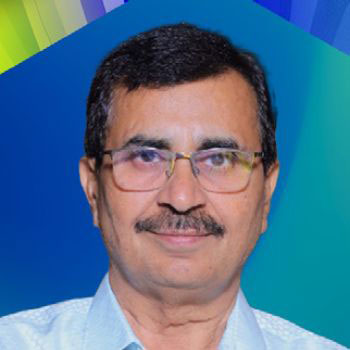
This year’s IMC theme ‘Innovate to Transform’ perfectly reflects our focus on leveraging 5G Advanced and 6G technologies to enhance connectivity while ensuring sustainability, inclusivity and affordability. The 6G symposium brings together India’s leading experts and global partners to exchange insights and strengthen collaboration. The integration of satellite, high-altitude platforms, and terrestrial 6G networks is a major global research direction. Japan plans to begin HighAltitude Platform System (HAPS) trials by 2026. Seamless handover between cellular, Wi-Fi, and satellite systems is expected to be critical for resilience and emergency response.
The integration of AI, quantum computing, and optical networking was described as a defining feature of 6G. Networks are expected to become AI-native, with intelligence embedded across all layers, from resource management to security. Optical and photonic technologies will be critical for data centres and interconnects, offering low-latency and energy-efficient solutions. Japan and Europe are leading research into all-photonic and quantum-enabled network architectures.
-Prof. R. David Koilpillai
Chairperson, Bharat 6G Alliance
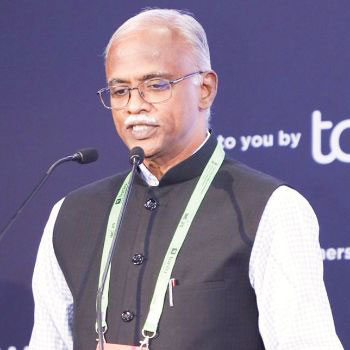
We all understand the importance of academiaindustry-government collaboration in building an indigenous 6G ecosystem rooted in innovation, interoperability and sustainability. India is not just participating but is very much in the race for 6G, actively seeking to contribute to its development, and we are committed to ensuring we have sufficient spectrum for these new technologies.
The transition from 5G to 6G is expected to be gradual, similar to previous generational changes.
Early chipsets will likely support both technologies, ensuring backward compatibility. There will probably be a single 6G standalone model without a non-standalone phase.
Speakers stressed the need to ensure affordable devices for developing regions and to use software-based AI upgrades to extend the life of existing hardware.
"The transition from 5G to 6G is expected to be gradual, similar to previous generational changes. Early chipsets will likely support both technologies, ensuring backward compatibility"
— Prof. R. David Koilpillai
THE EUROPEAN PERSPECTIVE

Magnus Ewerbring,
CTO, APAC, Ericsson
In our industry, we work with extremely long innovation cycles, sometimes spanning a decade or more. As we move toward 6G, we’re not just preparing networks for what we know today, but for the unknown possibilities of 2040 and beyond. Our focus now is to validate technologies that will be mature by 2030, setting a forward-looking standard that can support future applications from AI and cloudintegrated services to low-power IoT and XR experiences. The next generation of networks must be intelligent, energy efficient and capable of handling billions of interconnected devices seamlessly.
The Hexa-X 1 and Hexa-X 2 projects have now concluded, and the results — combined with other global research efforts — give us a clearer picture of what 6G will look like and what kinds of services will emerge from it.
We’re at a critical inflection point in the telecom industry. Over the past decade, mobile broadband has been built on the foundation of 4G and 5G. Most of us now have unlimited data plans and access to high-speed mobile services. The next step is to transform this mobile broadband, offering into a platform that delivers higher value.
The use cases themselves are already emerging. Mixed reality is one; we’ll likely see AI-enabled glasses arrive first, followed by truly augmented-reality experiences. Global connectivity through satellite integration is another. The first hybrid satellite-5G solutions already exist, and in the 6G era they’ll become fully integrated.
Communication with drones and other aerial devices is also becoming part of the network fabric, and so are mission critical networks, many of which are now transitioning to 5G. Herein, 6G will add new layers of capability, including sensing and spatial awareness — enabling networks to understand their environments and participate in more advanced services.
This naturally leads to the concept of digital twins — virtual replicas of networks, machines or even entire systems. For telecom operators, a digital twin of the network could allow autonomous operation and optimisation. For industries, digital twins will drive automation, efficiency and AI-driven decision-making. To keep these digital models accurate, constant data collection and real-time connectivity are essential — and that’s exactly where 6G comes in.
From a business perspective, 6G must enable new revenue streams. By transforming the network into a programmable platform, operators can offer differentiated connectivity services through APIs. Enterprises will be able to request specific network characteristics — low latency, high reliability or enhanced security — and pay accordingly once those requirements are verified.
Beyond connectivity, networks themselves will become rich sources of data — from location and timing information to environmental sensing. This contextual data can be shared via APIs or developed into higher-value applications for industries and developers. In other words, 6G won’t just connect devices; it will provide intelligence about the world around them.
Spectrum will, as always, be crucial. Regions are already working to identify new frequency bands, particularly in the upper mid-band and sub-terahertz ranges, to increase capacity and justify new network investments. Securing that spectrum will be key to driving the next wave of innovation.
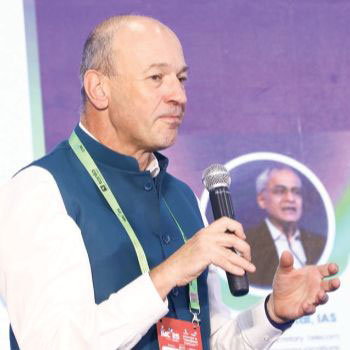
-Dr. Ulrich Dropmann,
Head
of Standardization and Industry
Environment, Nokia
When diverse activities challenges and expertise converge, collaboration becomes the driving force for progress. The ongoing discussions with technical experts and partner institutions have helped us analyse, refine and align solutions that are both globally relevant and cost-effective. From addressing complexities in spectrum and network frameworks to finalising technical studies for CCC, every step brings us closer to creating systems that are sustainable, scalable and continuously improving for the future.
As part of the inauguration ceremony, the Bharat 6G Alliance formalized collaborations through the exchange of Memoranda of Understanding (MoUs) with NASSCOM and the European Satellite Agency, further strengthening international partnerships for research and technology exchange. The event also saw the release of four Bharat 6G Alliance Working Group White Papers that outline India’s strategic vision and research directions in key areas such as spectrum roadmap for 6G in India, green and sustainable 6G in India, 6G Data architecture, security and exposure framework for Radio Frequency (RF) sensing and AI in network evolution to 5G Advanced and 6G.
The International Bharat 6G Symposium 2025 serves as a precursor to India’s broader engagement with global 6G forums, providing a platform for dialogues on key themes such as spectrum innovation, sustainability, AI-driven networks, security architectures, and cross-border collaboration. The symposium forms part of Bharat 6G Alliance’s ongoing efforts to position India at the forefront of global telecommunications innovation, empowering communities, industries, and governments with resilient, intelligent, and sustainable digital infrastructure.
"From addressing complexities in spectrum and network frameworks to finalising technical studies for CCC, every step brings us closer to creating systems that are sustainable, scalable and continuously improving for the future "
— Dr. Ulrich Dropmannbr
-Prof. Harald Haas,
Future Telecoms UK
on UK’s perspective on 6G initiatives and their
Future Telecoms Roadmap

International cooperation in 6G and beyond is absolutely essential. What we are collectively building is, in a sense, the “nervous system” of the planet — a single, interconnected digital fabric that must work for everyone. I’m happy to announce that the UK and India are launching a new strategic R&D partnership to jointly develop 6G technologies.
Let me start by saying that international cooperation and collaboration in 6G and beyond are absolutely essential. What we’re building is, in many ways, the world’s new nervous system—something that must be available to everyone and function as a unified global network to unlock its full potential.
Every generation of mobile technology has brought a paradigm shift. It’s possible that every even-numbered generation does so more profoundly. For 6G, that shift may just be like the move from raw bitstreams to intelligent data—towards meaning, context and AI-driven systems. This creates immense opportunities for integrating AI into standards and reshaping how networks operate.
"Every generation of mobile technology has brought a paradigm shift. It’s possible that every even-numbered generation does so more profoundly. For 6G, that shift may just be like the move from raw bitstreams to intelligent data—towards meaning, context and AI-driven systems"
-— Prof. Harald Haas
Let me briefly describe the four hubs, first, Telecom-Infrastructure-TelecommunicationsDr. Mike Short CBE, Chairman, AWTG The principles of action behind the next steps are absolutely critical to maintaining progress. As we think ahead to the India Mobile Congress and future standardisation work, we may not have solved everything today, but we’re on the right track. I’d like to leave three reflections for the next steps — cost, coverage and capacity. Cost needs rigorous thinking: international standards and R&D must keep costs low and scalable. Coverage must expand beyond cities into rural, remote and maritime areas through D networks, HAPS, and satellites. Capacity must be managed with design thinking, not just spectrum. The three Cs — cost, coverage and capacity — combined with collaboration, must guide our way forward. As a member of the organising committee and a representative from Europe, I must thank the Bharat 6G Alliance for the warm welcome and for the progress achieved since last year. Standardisation has significantly advanced, with active contributions to spectrum harmonisation at the ITU and the upcoming World Radiocommunication Conference. We’ve moved closer to defining 6G technical parameters, and soon we’ll begin proof-of-concept trials. The key now is to ensure regional initiatives align within one global framework so we can achieve cost efficiency and largescale interoperability. (avinash.rajput@corporatecitizen.in) Alliances-Networks (TITAN), which I lead at Cambridge, focuses on creating a network of networks by bringing together AI, radiocommunications, optical and fibre technologies, non-terrestrial networks and quantum systems. The goal is to build resilient, secure, sustainable and, eventually, self-healing networks powered by AI. Second, Imperial College, Professor Julie McCann leads the Communications Hub for Empowering Distributed Cloud Computing Applications and Research (CHEDDAR), which focuses on cloud and edge computing. Its research pillars include human-centric systems, sustainable systems, and verifiable AI—AI that is not only powerful but also explainable and reproducible. Third, Oxford, Professor Dominic O’Brien leads the third hub, which looks at the physical layer and studies spectrum in a much broader sense—radio, terahertz, sub-terahertz and optical frequencies. Fourth, Bristol hub, led by Professor Dimitra Simeonidou, has created a national testbed infrastructure for experimentation. It includes 11 “joiner nodes” that span the full network stack—from RF to optical switches—allowing large-scale trials. The aim is to soon run the first 6G trials on this network, including a space lab for non-terrestrial testing.
Across all hubs, key research themes include AI, cloudification, new hardware, spectrum management and AI-as-a-service. The UK’s 6G strategy aligns closely with 3GPP’s work, especially in integrated sensing and communication (ISAC), AI, non-terrestrial networks and sustainability. To conclude, the UK is fully committed to collaboration—particularly with India—on key areas such as AI, non-terrestrial and optical networks, and quantum communication.
INDUSTRY PERSPECTIVES ON IMPLEMENTATION
-Dr. Mike Short
CBE
Chairman, AWTG

The principles of action behind the next steps are absolutely critical to maintaining progress. As we think ahead to the India Mobile Congress and future standardisation work, we may not have solved everything today, but we’re on the right track. I’d like to leave three reflections for the next steps — cost, coverage and capacity. Cost needs rigorous thinking: international standards and R&D must keep costs low and scalable. Coverage must expand beyond cities into rural, remote and maritime areas through D networks, HAPS, and satellites. Capacity must be managed with design thinking, not just spectrum. The three Cs — cost, coverage and capacity — combined with collaboration, must guide our way forward. As a member of the organising committee and a representative from Europe, I must thank the Bharat 6G Alliance for the warm welcome and for the progress achieved since last year. Standardisation has significantly advanced, with active contributions to spectrum harmonisation at the ITU and the upcoming World Radiocommunication Conference. We’ve moved closer to defining 6G technical parameters, and soon we’ll begin proof-of-concept trials. The key now is to ensure regional initiatives align within one global framework so we can achieve cost efficiency and largescale interoperability.
Dr. Mallik Tatipamula,
CTO, Ericsson
Silicon Valley
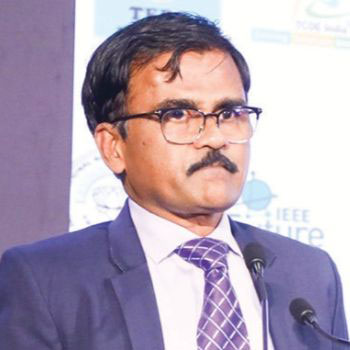
Over the last two days, we have discussed many topics to align technology standards and policies for the 6G roadmap. Since 2024, when we had the last symposium, the team has made tremendous progress: the first major milestone being the US– India collaboration through Next G Alliance, and the second, the India–UK collaboration on 6G. These events are creating enthusiasm and inspiration to bring countries together, because 6G means it has to be at planetary scale.
INDIA’S 6G JOURNEY
- 2022: Bharat 6G Vision unveiled
- 2023: Bharat 6G Alliance launched
- 2024: 6G testbeds set up
- 2025: International Bharat 6G Symposium at IMC
- 2030: (expected commercial) 6G rollout
To Sum It Up
The closing discussion emphasised that 6G is not merely an upgrade in telecommunications but a broader technological convergence combining AI, edge computing, photonic networking, and space systems. Collaboration, interoperability and inclusivity will shape the global 6G landscape. The United States, India, Japan and Europe are all aligning around common priorities: AI-native network design, security, sustainability, seamless integration of terrestrial and non-terrestrial systems, and open access to testbeds for research and innovation.