Volleyball: Spiking Future Skills

Residing in Shanghai, at the heart of Rajesh K. Pushpan and Dr. Jayabharathi Guptan’s journey lies a dream called Mintonette Plus, an academy that trains children in India free of cost for international volleyball tournaments. Equipped with the best international gear—from spiking machines to imported volleyballs— the academy is not just about perfecting the game, but about shaping young lives through exposure, discipline and confidence. Today, through Mintonette Plus, they blend sports, social responsibility and mentorship—giving India’s young athletes not just the skills to play volleyball, but win tournaments overseas
"At its core, Mintonette Plus is about more than volleyball. When these children return, they carry with them lessons on etiquette, exposure to new cultures, and confidence in themselves"
The spark of an idea
The turning point came during the Covid-19 pandemic. As lockdowns halted normal life, Rajesh felt a gnawing urge to 'give back'. He reconnected with old volleyball friends, Pratibha Prabhu, a former Maharashtra state player and Shiju Lonappan, another professional athlete. They discussed creating opportunities for schoolchildren once the world reopened. That’s how Mintonette Plus Sports Academy was born. The name itself carries history: when volleyball was invented in the 19th century, it was originally called “Mintonette”. Adding “Plus” was Jayabharathi’s idea, symbolising mentorship, growth, and something beyond the ordinary.
Unlike conventional academies, Mintonette Plus does not focus only on drills and matches. Instead, it adopts a holistic approach. Along with professional coaching, students would receive guidance from sports nutritionists and psychologists. “Kids often quit sports due to love affairs, family pressure, or academics,” Rajesh explains. “We wanted to build a system that helps them stay with the game and balance their lives,” he adds.
Building the next generation
Mintonette Plus Academy began its journey in Mumbai, conducting programmes at venues such as Nerul Gymkhana. The couple is soon expanding to Pune, partnering with like-minded individuals ready to invest their energy and resources.
Every detail reflects their commitment. Volleyballs, nets and kits are imported and distributed free. They have even invested in state-of-the-art training equipment such as spiking machines from Europe. International coaches have been brought in to expose students to global standards of play.
Perhaps the most radical decision that Jaya and Rajesh made was to ensure gender equality. Prize money at local tournaments, often skewed in favour of boys, was brought on par. “If a 14-year-old girl wins, she deserves the same recognition as any boy,” Rajesh insists.
Beyond borders: exposure and friendship
The academy’s mission is not just about competition but about broadening horizons. In the past year, 40 promising players—20 boys and 20 girls—were selected for advanced training. The best among them were given the chance to travel abroad.
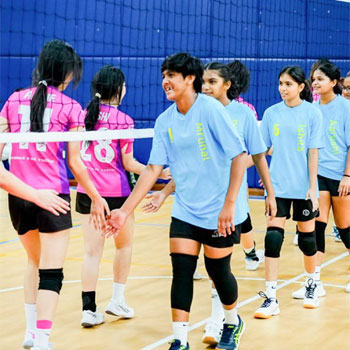
The girls’ team went to China, while the boys competed in Malaysia. The experiences were transformative. For many, it was their first flight, their first stay in international hotels, their first exposure to different cultures. “We told them that winning isn’t everything. Go there, enjoy, learn and make friends,” says Jayabharathi.
Indeed, friendships blossomed. Players exchanged contact details with their Chinese and Malaysian counterparts, and many continue to stay in touch on social media. For Rajesh, this cultural exchange was more rewarding than any trophy. “When I saw them mingling, exchanging Instagrams handles and forming friendships, I knew we had achieved something bigger than volleyball.
Challenges along the way
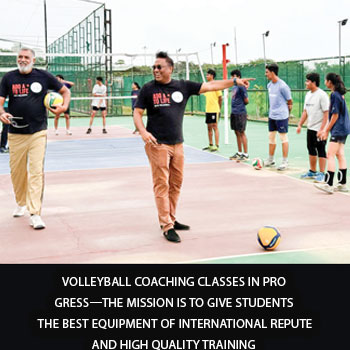
Running such an academy, however, is not without hurdles. Infrastructure remains the biggest challenge. Mumbai lacks enough indoor courts , making the rainy season a nightmare for training. “We’ve invested in world-class equipment, but during monsoons, outdoor courts are unusable,” Jayabharathi says.
They also face resistance from associations bogged down by politics. Offers to join associations as office bearers have been politely declined. “We’re not here for titles,” Rajesh says firmly. “We’re here to encourage kids.”
The academy runs largely on personal funds, supplemented by contributions from friends such as Pratibha, Shiju and Vijay. Coaches are paid, but the four founders dip into their own pockets to keep the initiative going. For Jayabharathi and Rajesh, this is a labour of love, not a commercial venture.
Dreams for the future
More than 200 students have already trained with Mintonette Plus. Their long-term vision is to host a Junior Premier League that would bring together clubs from across India and even invite international teams. Such a platform would not only popularise volleyball but also create opportunities for students who cannot afford the pathways available in cricket or football.
A legacy of values
At its core, Mintonette Plus is about more than volleyball. It is about instilling values of equality, resilience and cultural openness. “When these children return, they carry with them lessons on etiquette, exposure to new cultures, and confidence in themselves,” says Jayabharathi. “That’s as important as any skill on the court.”
Rajesh echoes the sentiment, “We’re not just training athletes. We’re shaping citizens. If every child who comes to us leaves with confidence and vision, we’ve succeeded.”
Together, Jayabharathi and Rajesh are proving that sport can be more than just a game; it can be a bridge to opportunity, friendship, and a brighter future for India’s next generation.
From garments to games
Rajesh’s early life revolved around the family business. His father owned a garment factory, and the family was deeply entrenched in the apparel industry. Following tradition, Rajesh completed his graduation, enrolled at the National Institute of Fashion Technology (NIFT), and began working in Mumbai. His career quickly took him abroad — first to Dubai in 1999, then to Oman, Jordan, the Philippines, and finally Shanghai, where he and Jayabharathi have now live for the past 18 years.
Yet beneath the world of garments and exports ran another passion: volleyball. Rajesh was a promising player in his youth, representing the junior Maharashtra University team. Though he never turned professional, the lessons stayed with him. “I tell every youngster, even if it’s not volleyball, play some team game,” he says. “It changes your confidence, communication, and leadership qualities. Sports teach you how to win, but also how to lose with dignity," he adds.
Volleyball shaped Rajesh’s destiny, when, on a trip to Kolkata for a university-level tournament, he encountered Jayabharathi, then a medical student. What began as a chance introduction after a championship dinner turned into a lasting friendship, and later, a romance. After nearly a decade of knowing each other, the couple married in 2001.
"More than 200 students have already trained with Mintonette Plus. Their long-term vision is to host a Junior Premier League that would bring together clubs from across India and even invite international teams"
A doctor with a social spirit
Jayabharathi’s world was very different. A homeopath by profession, she describes herself as “outdoor-loving but not sporty”. In her convent-school days she had played throwball, but medicine was her true calling. “When Rajesh and I were dating, he would be playing matches, and I’d sit on the sidelines cheering him on,” she remembers with a smile. “His enthusiasm was infectious. I may not have been on the court, but I became part of the game in my own way,” she adds.
Marriage, travel and relocation followed, with Rajesh immersed in his corporate career and Jayabharathi practicing medicine wherever they settled. But, alongside their professions, both became deeply involved in community work. Organising events, volunteering for cultural activities, and supporting social causes became part of their shared passion.