IITian’s road to Communal Harmony
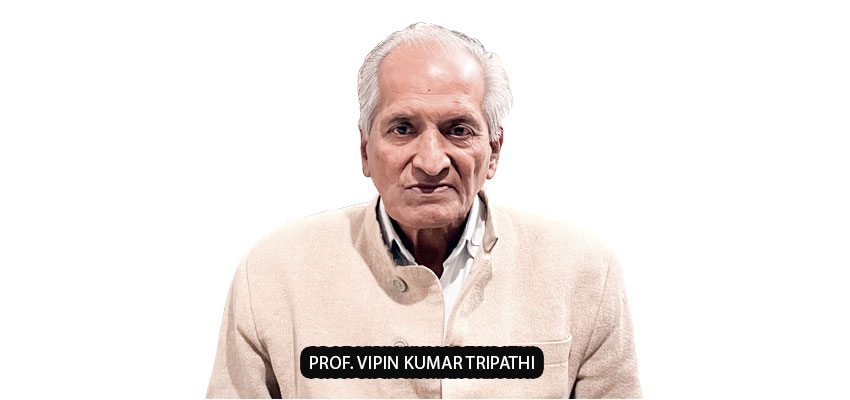
Balancing between science, service, intellect and empathy, Prof. Vipin Kumar Tripathi wears many hats—plasma physicists, activist and a former professor emeritus at the Indian Institute of Technology Delhi (IIT Delhi). Guided by Mahatma Gandhi’s wisdom, he fosters communal harmony by distributing pamphlets on the streets of Delhi—that carry a message of looking beyond religion, caste or community—as he believes, communal harmony is possible when we see each other as human beings
"Science teaches us to question, and secularism teaches us to see humans without prejudice. An education system built on these can strengthen democracy"
"Strength does not come from physical capacity. It comes from an indomitable will." — Mahatma Gandhi
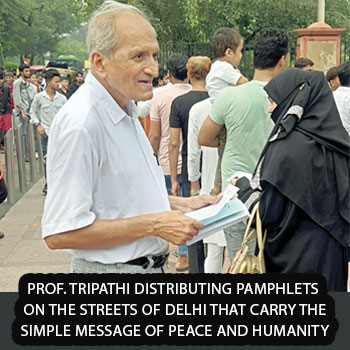
At seventy-seven, Prof. Vipin Kumar Tripathi often found standing at crowded street corners in Delhi, handing out pamphlets that speak of peace and humanity. The leaflets are simple, printed in black and white, written in clear language that ask the readers to remove prejudice from their hearts and remember humanity that connects us all. Some pedestrians stop to read, others deny politely and move on, but he never minds and continues his effort of strengthening social cohesion. In a remarkable initiative, the former IIT Delhi physicist, who once taught plasma physics and quantum theory, now chose the streets as his place of teaching.
One-of-a-kind approach
After decades of teaching physics at IIT Delhi, Prof. Tripathi could have spent his retirement in comfort. Instead, he spends his mornings writing and his evenings distributing pamphlets that call for compassion and unity. “Since childhood, I was taught that people of all religions, castes and communities are humans first,” he says. “I grew up hearing my father’s story on freedom struggle. When I entered college, I read Gandhi’s writings and decided that simplicity, truth, and service to peasants and workers should guide my life. These thoughts stayed with me.” His pamphlets reverberate those lessons.
Prof. Tripathi’s way of activism has always been firm and quiet. He writes, prints and distributes the leaflets himself. Over the years, he has handed out thousands of pamphlets to people outside metro stations, markets and university gates. He knows most people are too busy to stop for long debates, but he believes that a few lines read on a bus or at a tea stall can still bring change. “If even one in ten paused to understand, it is worthwhile,” he expresses.
A teacher shaped by teachers
“I was born a Hindu, but I was educated at the grassroots by a Muslim,” Prof. Tripathi often says, not as a line to impress but as the truth of his childhood. All credit, as Prof. Tripathi puts it, goes to Ahmed Baksh, a Muslim teacher in his village in Uttar Pradesh. “If it was not for my teacher, I would not have interest in academics,” he recalls. His teacher not only taught him mathematics and Hindi but also shaped him into the person he is today.
The second teacher was Mahatma Gandhi and his philosophy, which slowly became his own. “I spent two years in Jhansi, where Gandhi’s ideas became a part of daily living. Three things about Gandhi struck me most—non-violence, sacrifice for unity, and fight against untouchability. His compassion for those deprived of equal rights left a lasting impression on me,” he says.
After completing his post-graduation from Agra, Prof. Tripathi moved to Delhi for his Ph.D. By 1971, he was teaching physics at IIT Delhi. Students appreciated the way he explained ideas. “I always tried to make things simple because science should not be a burden—it should be a joy.”
A new chapter began when he moved to the United States. There he met Prof. Chuan Sheng Lu, a Chinese physicist who admired Gandhi even more deeply than he did. “Prof. Lu stood firmly against discrimination. His example reinforced my respect for Gandhi. My parents, teachers and Professor Lu—all of them deepened my connection to Gandhi. Through Prof. Lu, I also joined the international community of plasma physicists,” he expresses.
At the cross roads
His life took another turn after the Bhagalpur riots and the Ram Shila Poojan Andolan of 1989. He realised that this was against the soul of India. “These incidents brought a new chapter in my life. I told myself, my evenings and weekends cannot be only about research. I must speak against communalism,” he recalls. The Gujarat riots further deepened this belief. After visiting relief camps, he decided to teach mathematics to madrasa teachers. “If teachers from both sides interact, they will find a common ground,” he says. Conducting maths workshops for madrasa teachers overturned many stereotypes. “Teachers and students from Indian madrasas are among the most affectionate people I have met,” says Prof. Tripathi.
Science and secularism

For Prof. Tripathi, science and secularism are inseparable. “Science teaches us to question, and secularism teaches us to see humans without prejudice,” he says. He believes that an education system built on these can strengthen democracy. He often expresses concern about the state of education in India, “Though more students now attend universities, reaching about 20 per cent of the population, the number should be closer to 40 per cent. Education is costly, and many families cannot afford the fees. The government should share this burden.”
Prof. Tripathi also emphasises that real development must be inclusive, “I appeal to people to remove prejudice from their hearts. The real challenge is building an economy where students are self-reliant through both education and work.” Growth, as Prof. Tripathi says, should come from agriculture and small businesses, because machines in large industries increasingly replace workers. “Those who truly love their country should cast out hatred, free institutions from fear, and make colleges strong enough that any student can afford a good education,” he adds.
"During a campaign, I distribute 400-500 pamphlets a day. Many people I approach, stop to interact and discuss the issue"
The Sadbhav Mission
Prof. Tripathi’s campaign began with a simple practice of handing out leaflets. Even in the U.S., during the Ram Shila Poojan Aandolan, he contacted around 4000 people for a signature campaign and written many letters to ambassadors to raise awareness. Returning to India, he continued the effort, joined by students. “During a campaign, I distribute 400 to 500 pamphlets a day. Many people I approach, stop to interact and discuss the issue. Earlier, students from colleges and universities would join me. After 2014, largely I have to do it alone,” he says.
This quiet dedication evolved into the Sadbhav Mission—a grassroots initiative combining marches, workshops and lectures. “Alongside subject lessons, we always add one more lecture on humanity.” Through it all, his principle has remained simple—remove prejudice. “Those who love India must remove hatred from their hearts,” he says. “Free our institutions from fear. Let every student, no matter how poor, study without worry.”
And, what drives him after so many decades? His answer is natural, “When I see people in pain, I don’t worry how effective my actions might appear. My concern is succour—helping in any way I can. That brings me peace,” he signs off.