The Power of RURAL RESILIENCE
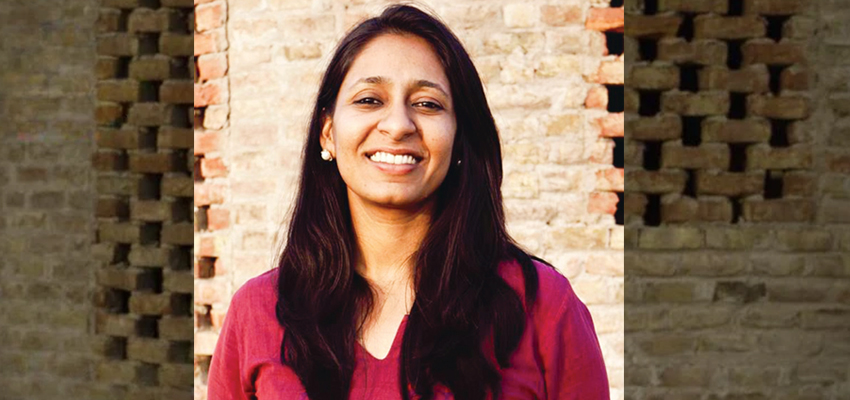
She exemplifies rural resilience, making Rajasthan's borderland her home and the local community her family. Founder and director of Samakhya Sustainable Alternatives, Prerna Agarwal, relinquished her lucrative corporate career at top agencies including Ogilvy, to embrace rural entrepreneurship, when she packed her bags and moved to a village bordering India and Pakistan. She joined NGO Urmul, as CEO of their crafts programme, and developed the Urmul Desert Crafts brand, creating market access for over 5,000 artisans from disadvantaged backgrounds. She also helped revive traditional textile practices and sustainable natural fibres. Prerna now pioneers community-led enterprises through her Delhi-based company, demonstrating her corporate skills in driving sustainable rural development and empowering traditional craftsmanship. She talks to Corporate Citizen, on her journey of transformation from a firebrand corporate professional to a rural entrepreneur
Corporate Citizen: What were your initial challenges when you decided to switch professions?
Prerna Agarwal: Convincing my parents to let me shift base to a village in Rajasthan was the biggest challenge. A standard response was, “People migrate from villages to cities; and you are migrating from city to a village. Who does that?” But, after seeing my conviction and the existing stressful life that I was leading, they agreed on the pretext that, if nothing, she will gain experience.
CC: How did you acclimatise to rural life?
Since I had no specific context of the region or village life, there were no expectations or presumptions. I started my rural journey in the peak summers, so the very first months taught me how not to waste water and reduce personal waste. I stopped wasteful spending on useless things we don't even use. I began to realise my inner strength. I could have never imagined that I could survive without ACs or coolers, and many times even without a fan, and I began enjoying the cool shade of the neem tree. These experiences and my interactions with the local communities, whom I assisted in increasing their revenue, became the reasons for me to stay back. The place taught me true contentment.
CC: What were your immediate learnings?
The geographical and lifestyle changes have made a lasting impact. Personally, the experience helped build resilience and patience. I learnt to work with 360 pastoralists (cattle farmers) and 600 women artisans, gradually building deep community trust.
CC: How different is rural entrepreneurship from urban job roles?
The one difference that I experienced in the rural landscape is that even whilst making profits, wellbeing is utmost for all, and the mental struggle to complete a deadline need not be stressful. The idea is to integrate social life with work-life and still earn income. Therefore, our model is based on community alignment because if an artisan or labourer is burnt out, it would impact their entire family, also our workings. While we work within our own ecosystem, we thrive to strengthen it and build alliance with larger ecosystems, as our model can be sustained through networking and alliances.
CC: How did an outsider from Delhi's corporate world earn the confidence of traditional communities?
The biggest reason why communities work with us is because we have transitioned from being urban individuals to becoming one of them. Most of our team is from the villages or living in villages. For us, community trust is the very fundamental foundation of our work and life. Since I have been living in the village for almost 10 years now, people know where to find me or my team. We are no more from a foreign culture. We speak the same language, eat the same food, face the harshness of the land, participate in personal events, in good times or bad, stay connected and are as much a part of their village. And most importantly, we ensure that we respect our commitments.
CC: What is the concept behind Samakhya and how do you sustain them economically and socially?
Samakhya means a collective where everyone is equal. We are building an interconnected, interdependent ecosystem of smaller collectives or groups of communities, which are further linked with the for-profit entity. The mesh-like working model reduces the risk of death and ensures economic and social sustainability that we learnt from my earlier days working with the NGO Urmul. Our model covers the entire band from Jodhpur, Bikaner, Nagaur to Jaisalmer. Thus, working within larger ecosystems keeps all the wheels working.
"The rural communities here believe in mutual growth financially and beyond in creating a good profit margin, that garners trustworthiness in building the business "
— Prerna Agarwal
CC: With regards to 'traceable, ecofriendly wool products', how do you build transparency from the pastoral to the endconsumer chain?
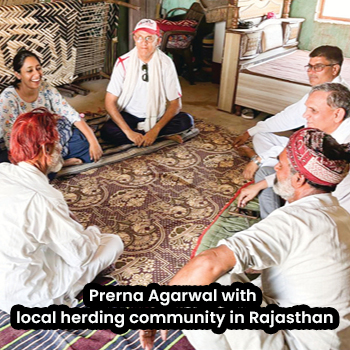
Our entire backend is traceable, right to the pastoralist. We are now working on creating digital system to integrate all the data, collected through our groundwork. It is easier for us because we are not the secondary player in the chain. We are the primary entity, working directly with communities.
CC: What's been your biggest setback in this journey, and how did it change your approach to building Samakhya?
I am a student of systems engineering. I have learnt to create long-lasting relationships and systems, which grow along with people, and not despite them. The idea is to be one with its environment and not merely extracting from it. This is not a mythical or hypothetical system. These systems exist in villages, across institutions which have survived despite all odds. I am paving baby steps, but have a larger vision for collective consciousness with Samakhya.
CC: What does 'build the next billion' mean to you?
We work primarily with people, especially those who are far away from usual notional opportunities. India's urban spaces are now saturated and hence the next phase of growth will come from smaller towns and villages. This is where we hope to impact as part of the next billion growth.
CC: How do you balance profit with purpose?
I would say profit is the fundamental truth of business. Purpose and profit are on the same side of the question. The real question is whether we seek long-term or short-term profit. Akin to the Tatas who created generational wealth not just for themselves but for the entire country, we believe we can seek to do the same for our pastoral community.
CC: How do you handle the tension between preserving traditional methods and introducing innovations for market viability?
In building romanticism and in preserving traditions, we often forget the origins and evolution of these traditions in the first place and their future impacts. If villages had sustained their people in the past, none of our forefathers would have migrated out to cities. And the same is happening today. We need to innovate, but focus on local innovations, ensuring that these systems continue to evolve and support their people or community.
CC: When did you discover that indigenous wool was being discarded at Rs 20 per kg in Bajju, and what opportunity did you see in the wasted material?
In deserts specifically and rural economy in general, family income is designed on the principle of risk mitigation. So, the same family will partake in agriculture, animal husbandry, including craftsmanship, to ensure that there is always a source of income, even during harsh weather conditions or unexpected drought. While working with the artisans in villages, I learnt about indigenous sheep herders and their struggle for survival. These herders spent almost 8 months out of their homes travelling 800-1000 km on foot with their animals, leaving their women and children behind, in search of fodder, water and markets for their animals. The local herders were literally throwing away their wool fibres at almost no cost, because there was no organised market or extremely low rates given by the middlemen.
CC: How did you identify that coarse wool could be repurposed as insulation material for the construction industry?
We reverse engineered the problem of nomadic herders to create a market for the coarse fibre produced by the indigenous breeds, keeping in mind the changing climatic conditions and their impact on the markets. With apparel and carpet industry shifting towards softer and cheaper alternatives, we felt our fibre was rejected by these markets based on the market preference. However, coarse fibre is most appropriate for insulation applications because of its hollow core. We realised that the construction industry was struggling with high energy and carbon emissions and could benefit a lot more from the coarse fibre.
"The one difference that I experienced in the rural landscape is that even whilst making profits, wellbeing is utmost for all, and the mental struggle to complete a deadline need not be stressful. The idea is to integrate social life with work-life and still earn income "
CC: Do share your early experiments.
Our first experiments were in our own buildings and trials, where we tested its acoustic and thermal performance by replacing glass wool in community digital training centre, a dairy cold room, and milk can chillers. And, the results were baffling. The fibre created a temperature delta of 10-14 degrees in extreme heat conditions. The higher the temperature, the better it performed. In the second phase, we tested the material with the Indian Army in Kargil War in extreme cold conditions. Yet again, we saw a brilliant performance in terms of temperature delta and noticed that the thermal layer reduced the usage of kerosene lamps (used for heating purposes) to almost half. The success opened the door for more such research and hence confirmed that our material has the potential to save almost 30- 40% of energy bills for the users, especially in urban areas.
CC: What other traditional materials or practices are you looking to revive, and why?
Pastoral fibre by itself is such a vast category that it will take us years to cover the entire length and breadth of this segment. Once coarse sheep wool is stabilised, we are looking at many such fibres such as camel, goat, yak and so on.
CC: What has been your biggest learning in rural entrepreneurship?
This is the longest I have stayed with any organisation for a decade when previously it was always an average of 3 years within my urban zones and corporate roles. The rural communities here believe in mutual growth financially and beyond in creating a good profit margin, that garners trustworthiness in building the business. Doing business through mutual incentives, enables both Samakhya and the communities to grow together.
CC: You are an Acumen Fellow (2021) and a G P Birla Fellow (2022). How have these programs shaped your approach to social entrepreneurship and leadership?
Leadership is a very lonely journey. Especially when you have uprooted yourself from your family and friends, and replanted yourself in a new space and culture. The fellowships gave me respite, friendships and guidance when I needed them the most. Sharing and discussing problems with people from similar systems, helps get a fresh perspective. I found business partnerships, personal mentoring and exposure to fresh ideas through these fellowships, which helps me to overcome the daily operational grind.
CC: How do you define success now versus your definition during your corporate days?
My definition of success earlier, was restricted only to 'my' personal growth. Today, it has evolved to 'us'. Today my individual growth comes secondary to the growth of the people I am working with and working for.