Smarter Consulting, Lasting Impact
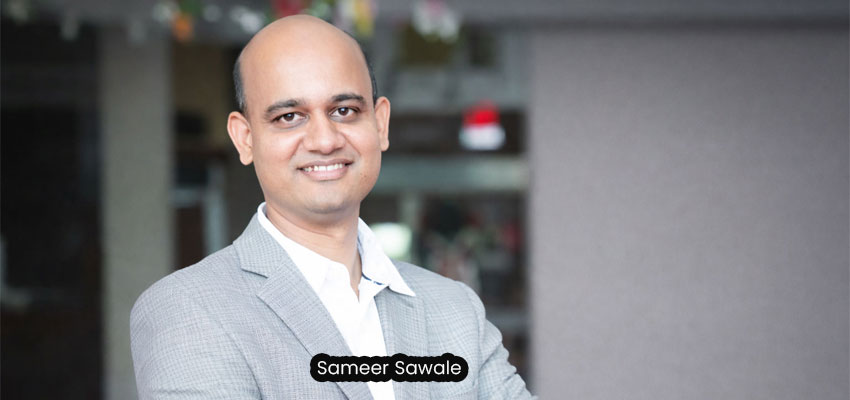
With a career spanning over a decade, across operations, strategy and transformation consulting, Sameer Sawale currently serves as Project Director at Goldratt Consulting, a firm well-known for the Theory of Constraints (TOC) to solve complex business challenges. Sameer is a graduate of IIM Calcutta and has built deep expertise in driving large-scale consulting engagements across industries. In conversation with Corporate Citizen, he walks us through the core ideas that shape effective consulting and lasting business impact, from applying TOC in real projects to overcoming bottlenecks in businesses
Corporate Citizen: Could you walk us through your professional journey?
Sameer Sawale: My professional journey began in 2009, after completing my mechanical engineering at Veermata Jijabai Technological Institute (VJTI), Mumbai. My first job was with Hindustan Petroleum—I worked at an airport for managing refueling operations. I was there for three years, and then I realised that to move up the ladder, I needed to enhance my capabilities. That’s when I took a break and pursued a two-year full-time MBA from IIM Calcutta.
During the MBA, I realised that I had a knack or hunger for problem-solving, and that’s where consulting came into the picture. I got placed through campus in Vector Consulting Group. I worked there for around four to five years. Later, I moved to Goldratt Consulting, where I am currently working.
I now have close to 12 years of consulting experience, working across industries including automobiles, consumer goods, steel, spare parts and fashion. Hence fortunately, I’ve had diversified client exposure so far.
CC: What led to your shift from engineering to consulting?
You can shift from any engineering background to consulting. In fact, most companies have some manufacturing operations. While I don’t use my technical skills directly, I am not clueless about such environments because of my background in mechanical engineering and the job I did after my education. So, it really helps me to have a basic idea about the kind of domains I am into.
CC: How would you explain “management consulting” in layman’s terms?
In layman’s terms, what a management consultant does is, let’s say when you’re driving a car, your vision is limited, you can’t see beyond 50 or 100 metres. But, if there is a co-passenger, he can see much beyond that. The corporates and the companies, are those drivers—they are so engrossed in their day-to-day activities. We, the management consultants, are the co- passengers who can really see beyond what is there today. We can foresee the challenges and tell what the next thing can be to do for the organisation’s growth, since we have that bandwidth and experience.
To go into consulting, you should have an interest in problem solving, because that's essentially what consultants do. You should also learn certain man- agement frameworks through books
— Sameer Sawale
CC: What are your roles and responsibilities as Project Director at Goldratt Consulting?

I handle multiple clients at a time. My job is to ensure that we transform our client organisations. We have really taken a target of doubling the revenues of some companies, which were in distress because of working capital pressure; and we have released a lot of working capital through our solution.
My objective is to ensure that I am rightfully understanding the problem, getting a proper solution, and getting it implemented. So, my day involves a lot of interaction with the top management of companies. My team is completely hands-on, working on the ground to get things done.
CC: Goldratt Consulting is globally known for its application of the Theory of Constraints (TOC). For those unfamiliar, how would you explain TOC in simple terms?
TOC is a management philosophy or rather a theory, which helps you look at an organisation in a very holistic way, just like the way a doctor looks at our body. He doesn’t look at just the hand or the leg, he looks at the entire body. So, if you go to a doctor with a problem like knee pain, he will still ask you questions related to your eating habits or something else. Since he can think holistically, he can understand the cause and effect.
This is exactly what TOC does to the corporate world, or rather to any system. Corporate is one such system—your personal life, education or healthcare, can also be considered systems. You can look at any system holistically, understand the pain points, address the root cause, and the results will come.
CC: Is TOC a complex framework?
It’s actually very simple. TOC has four fundamental principles. One of the principles is, everything in life is very simple. You just need to understand the cause and effect between various things, and you will understand the simplicity of it. On the other hand, if you look at things in isolation, you will find everything complex. Understanding the cause and effect helps you know where to attack.
CC: How is TOC relevant in today’s business world?
It is very relevant. I see that today’s business world is very much inclined towards having sophisticated and complicated systems, which are good for local improvements. But, if you want to make some holistic improvement, then you must go beyond that. This is something the world has realised, and we have been practicing TOC for close to three decades now.
If you see Japan, from where a lot of theories have emerged—it is one country which has adopted TOC the most in the entire world. Imagine, if a country like Japan is adapting TOC despite having such an efficient system, how relevant it is to everybody else.
CC: Do Indian companies implement TOC?
Yes. From around 2002–2003, Tata Steel first started implementing TOC. They were the first to invite Dr. Eliyahu Goldratt (father of TOC) to India. They showed tremendous success, and a couple of big names also picked up TOC. They have become like the lighthouse of TOC that everybody wants to follow. I see now many companies are doing it—a lot of known names are implementing it, and many TOC consultants are flourishing.
CC: Can you share a project example of how applying TOC led to significant business impact?
There are many examples, but one that I would like to share is of a company involved in the electrical industry. They had a problem with their inventory and had a low fill rate. Fill rate refers to a company’s ability to fulfil customer orders from the available inventory. It’s like, if you want to improve the availability of products, you will have to produce more and keep more, which means your inventory will go up. That’s what they were trying to deal with.
So, the challenge we took was, how can we reduce the inventory and still maintain or improve the availability of products? In about eight months’ time, we reduced their inventory by half and improved the fill rate from around 70 to 97 per cent. That was a tremendous improvement for the company. And, this was not just an improvement in the results, but also in the overall way the company conducts its operations.
CC: Apart from TOC, what other management frameworks are used to address project challenges and drive business success?
There are many frameworks and tools that you will see. There is one called Lean Management, and then there is the Toyota Production System, which is a subset of that. Some frameworks are developed by individual companies. There is also Management by Objectives and Key Performance Indicators (KPIs). You will be able to find many such things in the literature.
"Beyond numbers, we see how people’s behaviour has changed, and that is a very good trigger for us to know whether we have achieved success in the project or not "
CC: In your experience, what are the most common bottlenecks Indian companies face today?

The first is mindset, but that is something which is generic. If you want to get specific, I feel that our basic operational capabilities are not up to the mark. To grow big, to build a tower, you need to have a solid foundation, and that foundation is operations.
I see a lot of inefficient ways in which our companies are currently operating, be it procurement, production or in-plant operations. If you plug those and then do any kind of improvement, you have a solid base. All you see then is the next level of improvement.
CC: You mentioned mindset as a bottleneck. Could you elaborate on that?
There are certain bottlenecks I see in people’s mindsets. One is having the “I know everything” mentality. If you say, “I know everything”, then intuitively you are blocking yourself from thinking beyond what you know. You won’t be receptive to feedback or new insights, and you will lose out on many things.
I see this as a very big bottleneck, particularly in the top management of companies. But on the other hand, there are some people who take a step back, keep their ego aside, and explore and try something new. We see a lot of success there.
CC: How do you handle resistance to change, especially when the solution contradicts the established business norms or beliefs?
Whenever you are making a change and seeing resistance to that change, rather than getting hyper about it, you just need to understand the mindset of the person. See where he is—just do a genuine check.
What we see is, first of all, whatever change you are proposing, what is the problem that the change is solving for that person? And then, see if that person is also clear that this particular change is going to solve his problem. If he feels that the problem is really big and the proposed change is going to solve it, then you really don’t need to take much effort. The person will accept it, because it is going to make his life easier.
We have a six-layer resistance framework, in which the first is to reach an agreement on the problem. Beyond this, we see that if the person is saying no, is it because he is afraid or doesn’t have the authority, or is there something we are not aware of? If we think everything is perfect but the person is still not budging, then we go to his boss. It gets things done.
CC: How do you measure success in your consulting projects? Is it purely financial, or does it go deeper?
No, it goes beyond that. Financials are just numbers. We always try to translate numbers into physicality. So, when we say physicality—what is the physical change that has happened in the organisation? Are people doing things in the same way they were doing before? If the answer is no, then things have really changed.
I am then confident that the change is going to be sustainable—such that after a few months, even if I am not there, the success will last. So, beyond numbers, we see how people’s behaviour has changed, and that is a very good trigger for us to know whether we have achieved success in the project or not.
CC: How is AI impacting the field of management consulting?
Many consulting firms view AI as a threat, since tools like ChatGPT can now perform tasks traditionally done by consultants, such as analysis and providing advice. However, I see it more as an opportunity than a threat. It’s going to help people be more efficient. Things which used to take hours may now take just a few minutes. That will release a lot of our bandwidth, and we will be able to focus on something which probably AI is not doing.
The only care we have to take is, we should not lose track of our thinking abilities. If AI is doing everything and we are not thinking, then eventually, we will lose our intuition.
"For long-term success in business, you should always have a holistic view. You should look beyond today, and you should be open to improvements. The “I know” attitude, is a huge blocker, especially among the owners of the companies"
CC: What skills and qualities should one develop to succeed in management consulting, and what advice would you give to aspiring consultants or young professionals interested in this field?
To go into consulting, you should have an interest in problem solving, because that's essentially what consultants do. You should also learn certain management frameworks through books. I am not saying you need to learn everything; you just need to know the basics of everything. For instance, if you want to get into consulting, you should know the basics of finance along with the basics of marketing and operations.
You need to learn the fundamentals, because when you encounter a problem as a management consultant, it doesn’t come to you saying that it’s a finance problem, for example. The problem can come from any domain, and we should have the aptitude to see what the correlations are. So, even if you’re not an expert in finance, if you know the basics, you will at least know whom to get to. Hence, you should try to learn the basics of everything.
I would also say attitude is very important. When you go to a doctor and walk into that room, the first impression is the last impression. You notice how he is dressed and how confident he looks, because you know his advice is going to impact your life. Likewise, companies look at us. We are the doctors for companies. And, if we don’t have the right attitude, body language or mindset, they might feel shaky, thinking that we are paying a huge amount to this person and taking a bet on him, and if things don’t turn out, we are taking a risk here.
So, you should keep an eye on aspects like attitude, confidence, knack for problem solving, and better communication.
CC: Finally, if you had to distill one principle that drives long-term business success, what would it be?
For long-term success in business, you should always have a holistic view. You should look beyond today, and you should be open to improvements. The “I know” attitude, which I mentioned earlier, is a huge blocker, especially among the owners of the companies.
If you see a pattern in those who succeed, they always have the hunger to learn. They always ensure that they give space to the right set of people. There should be humility to accept that “I don’t know everything”, and if I really want to move forward, I need support.