Building Trust Before Technology
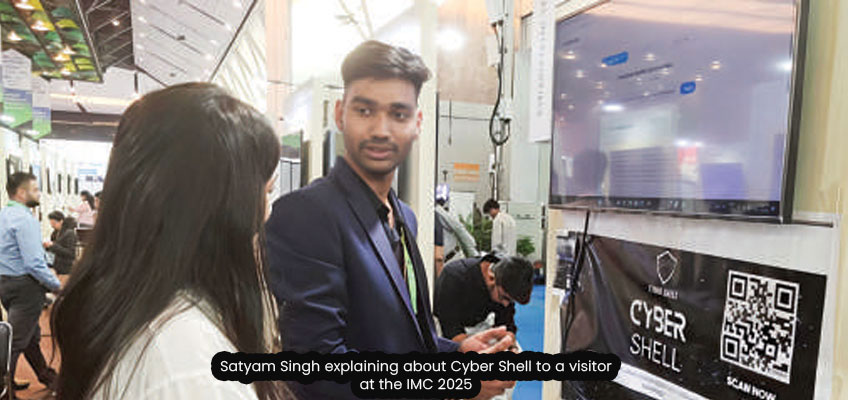
With the increase in technology adoption, digital awareness and cybersecurity literacy remain limited. Everyday, people fall victim to phishing links, scam calls, and misleading online content. Cyber Shell, a digital guardian startup, grew out of this gap. Founded and developed by Satyam Singh and his team, this evolving AI-driven digital safety platform resolves major cybersecurity concerns
The idea, founder Satyam Singh explains, came from watching people around him struggle to tell real from fake online. “We wanted to build a platform that empowers users to verify and protect themselves in real time, and that’s how Cyber Shell was born,” he says. This AI-driven digital safety platform is designed to detect fake news, phishing links and scam numbers, helping people stay safe online with confidence.
When the idea took shape

A student of bachelor’s in computer applications (software development) at SBUP’s School of Computer Studies, Satyam joined SrujanHub - Entrepreneurship Development and Incubation Foundation (EDIF), where he came across the idea of establishing his startup. Multiple brainstorming sessions, deep research and discussions with mentors helped Satyam tread the path of shaping his idea into a working model. “SRUJAN provided the perfect launchpad for transforming our concept into a structured, executable startup. Through its guidance, we were able to validate our idea, understand the problem scope, and refine our features for real-world use,” he shares.
Mentorship sessions and discussions with industry experts helped Satyam and his team members, Sandeep Baghel, co-founder and Sneha Maiti, technical member, shape their business model, improve its user interface, and focus on scalability.
Support and recognition at the IMC
After transforming the idea into a working model, the team participated at IMC Aspire—the flagship startup programme of the India Mobile Congress (IMC) 2025—for support and exposure. Although the team did not receive direct funding at IMC, the learning was just as valuable. “The feedback and validation we received reinforced our belief that digital safety is not just a tech idea—it’s a social need,” Satyam says. Many visitors at their stall suggested partnerships with government bodies and CSR programmes, focused on cybersecurity.
Pitching at IMC 2025 was a turning point. The team had the chance to present Cyber Shell to entrepreneurs, faculty and potential collaborators. The feedback was sharp and practical. “It helped us communicate our mission more clearly.
The questions and suggestions from experts challenged us to think more deeply about technical scalability, user acquisition and monetisation,” Satyam recalls. Their stall drew more than 150 visitors who tried the live demo. Many checked suspicious links, fake news and scam numbers on the spot. “The strong response gave us the confidence that the problem we were solving mattered to ordinary users,” he says.
Overcoming challenges
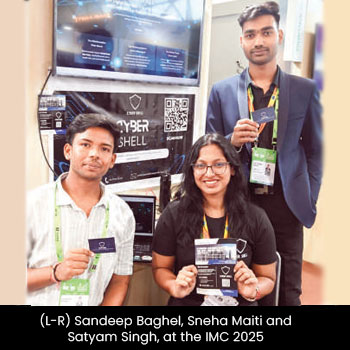
Like most young teams, Cyber Shell had its share of hurdles. Limited technical resources, finding free and reliable APIs, integrating APIs without a backend infrastructure and difficulty in handling AI models made the journey challenging. “There were days when nothing worked,” Satyam says. They got through it with continuous learning, creative workarounds, and mentorship from SRUJAN and IMC. “Each challenge strengthened our problem-solving mindset and helped us build a more efficient MVP,” he adds.
People behind the vision
While Satyam leads the startup, managing product design, AI integration, and overall development, the core team consists of students passionate about cybersecurity, AI, and digital empowerment. Each member brings unique skills—from backend development to content creation—united by one goal, making India’s digital world safer and smarter.
Under the guidance of the experts and mentors, the team is now focusing on improving verification accuracy, adding stronger fraud-detection APIs, and launching public Telegram and internet bots. They plan to collaborate with organisations on digital literacy programmes, release a public scam-tracking dashboard, and introduce a freemium model along with B2B integrations.
Looking ahead, Cyber Shell hopes to become India’s trusted digital safety assistant. Their long-term roadmap includes AI-based fraud detection APIs, nationwide awareness efforts, and partnerships with institutions and governments. As Satyam puts it, “We want every Indian to feel safe online, not scared.”