A Soldier’s Second Service
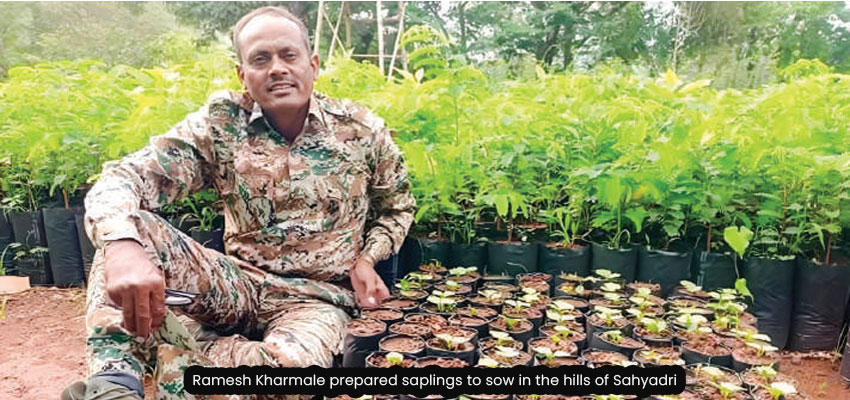
In Pune’s Junnar district, when the first light of dawn falls on the Sahyadri mountain range, Ramesh Kharmale, with a pickaxe in his hand starts digging trenches to sow seeds and water furrows, to irrigate them. An ex-serviceman, currently working as forest guard with Junnar Forest Division, he has dedicated his entire life protecting and conserving the nature. Once a soldier who protected borders, now protects the environment. Kharmale believes that future generations should experience the beauty of nature that the past generation once lived with
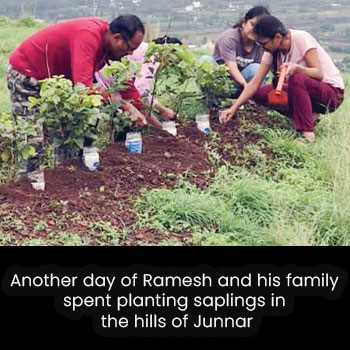
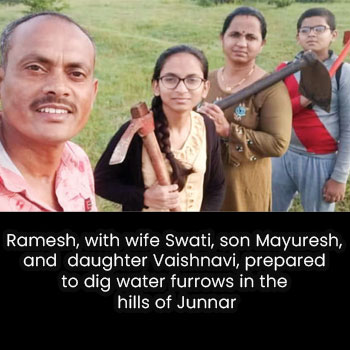
From 9 am to 5 pm Ramesh performs his duty as a forest guard, while during his off duty hours he is seen on Junnar’s Sahyadri mountains, discovering new ponds, seasonal waterfalls, throwing seed balls, sowing seeds, planting saplings, digging water furrows, cutting unwanted grass, and educating youth on nature conservation. This huge task is a family affair. His wife Swati and their children, Mayuresh and Vaishnavi, accompany him on the ground. “Growing trees and keeping them alive is our job. Together, we have planted thousands of trees and dug 70 water furrows, where we also planted over 447 trees, and built small water points for birds and animals,” he says.
From battlefield to the land of Junnar
After retiring from the Indian Army as Hawaldar in 2012, Ramesh worked in a bank as a guard for about eight months. “While working in the city, I realised that routine security work was not for me. I have served the Army and have to do something for society,” he says. This burning desire brought him to Junnar in 2014. He and his family settled in Junnar, a town known for its forts and ancient history, but often overlooked for its fragile ecology.
As soon as Ramesh began exploring the town, he observed that not only nature but also people living in some parts of the Sahyadri ranges were suffering. People in the tribal region lacked even basic facilities and often travelled to the eastern region of Junnar to work as labourers. “Seeing their struggles, I felt that with some financial support, they could build something of their own. That’s when I decided to promote tourism in Junnar,” he recalls.
Within a year, he photographed and wrote articles on Junnar’s beauty to attract visitors to its forts. Back then, as Ramesh says, tourism was mostly limited to Shivneri Fort. “I wanted people to see more. Since then, I have written over 4,500 articles and taken more than two lakh photos of Junnar, all shared on my Facebook group Nisargmay Junnar Taluka (Nature-Blessed Junnar),” he says. He started visiting schools across Junnar to show students the town’s natural beauty and also rescued both people and animals stuck in the ghats. He also wrote a book, Jagen Maybhu Tuzyasathi (I Live for You, Mother Earth), which tells the stories of his rescue missions.
“During this time, I realised that serving nature is as meaningful as serving the country and people. Hence, I started exploring Junnar’s forests and hills and later joined Junnar Forest Division under Maharashtra Forest Department as forest guard. Even then, I continued writing and photographing,” he adds.
Restoring forest
In the beginning, Ramesh used to visit the hills of Junnar on holidays. To his surprise, he saw how plants were not getting enough water even after bountiful showers. After a thorough inspection, he started visiting the hills daily to dig trenches, trapping rainwater and preventing soil erosion. It was hard, physical work, often done before sunrise or after his daytime job as a forest guard. “Over these years, we have dug more than 70 water furrows and built four ponds—all for the trees, birds and animals. We have kept the ponds out-of-sight to avoid human interference,” he says.
While he and his children took on the role of digging trenches, sowing seeds, planting saplings, and making seed balls, his wife took responsibility for cleaning and reviving degraded ponds and even stepwells built in the era of Chhatrapati Shivaji Maharaj, to help animals find water easily. Ramesh and his wife have recently completed B.Sc in Agriculture to improve their conservation work.
They don’t seek donations. “We use our own savings. Even when people offer financial help, I politely refuse and instead ask them to join me in planting or watering trees.”
"Growing trees and keeping them alive is our job. We have planted thousands of trees and dug 70 water furrows, where we also planted over 447 trees, and built small water points for birds and animals"
—Ramesh Kharmale
A life dedicated to mother nature
Ramesh’s daily routine has little room for rest. He starts his work on the hills at 5 am and continues till 9 am, performs his duty as a forest guard from 9 am to 5 pm, then spends his evenings watering saplings or writing environmental blogs till 10 pm. He spends his weekends in the hills with his family, maintaining trenches or cutting grass for kilometres. “Money is not our motto. If animals can live by nature’s rules, so can we,” he insists.
He even started a small toll system at Naneghat, one of the region’s popular trekking spots, with the help of Forest Department, Junnar. The funds collected over months go directly into cleaning drives and hiring local youth to remove plastic waste from the hillsides.
Over a decade, Ramesh has also visited more than 400 schools to teach students about protecting nature, and has even developed an oxygen park.
Ramesh has inspired numerous youth from different parts of Maharahstra, who now lead this initiative of conserving nature. The change has been so inspiring that a teenager, after hearing his talks, dug 29 water furrows in the Sahyadri hills in just 17 days. “I don’t want a crowd to follow me. I want to train youth who can work independently and inspire others. I’m proud to say that I have trained many such people who later share their success stories. Hearing their stories bring me joy,” he grins.
Full circle of service
His educational approach gained formal recognition when a documentary about him and his wife, Couple for the Environment, produced by Savitribai Phule Pune University’s Educational Multimedia Research Centre, won the Best Educational Programme in the government institutions category, at a North East Regional Institute of Education event in Shillong. The film highlights their work and philosophy of serving nature as a form of national service. Working for the cause of nature has also brought numerous honours to Ramesh’s life. He has received over 200 awards, including the Indian Army’s Veteran Achiever Award 2025. He was also invited by President Droupadi Murmu for a dinner on the occasion of Independence Day 2025. In addition, his work was featured in Prime Minister Narendra Modi’s 'Mann Ki Baat' programme in 2025.
From protecting borders to nurturing different kind of boundaries, Ramesh’s life has come full circle. In a world where people seek attention for their social work, his approach is down-to-earth. As he often tells students during his school visits, “The earth remembers what you give it. You just have to start with your own two hands.”