Celeb lawyer finding his niche
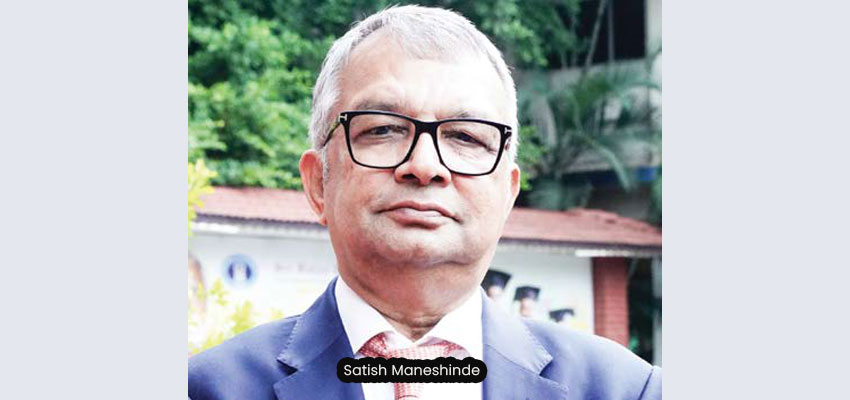
The line between justice and drama often blurs, and that’s where Senior Advocate Satish Maneshinde’s, story cuts through the noise. His journey has the kind of arc you’d expect in a gripping legal drama: a young boy from a modest family in Karnataka who finds his way to Mumbai, earns a place in the chambers of the legendary Ram Jethmalani, and steadily becomes one of the most recognised names in criminal law. In a conversation with Corporate Citizen, Maneshinde looks back at the early years that shaped his grit, the cases that sharpened his instincts and the guiding principles that keep him steady in the middle of India’s most high-pressure legal battles
Ccrporate Citizen: You’ve had a long and illustrious legal career. Can you take us back to your early days and tell us about your journey?
Satish Maneshinde:I belong to a family where my father was a government servant. He was a clerk in the revenue department in Karnataka. There were six of us—three boys and three girls. My father had a very meager salary, so he prepared us to join Sainik School, Bijapur. That’s a military school set up by the Defence Ministry. I was successful in joining the school because I cleared All-India competitive examination. He wanted me to join this school at that time—even today, it is considered prestigious because the Defence Ministry runs it. I finished my schooling in 1976. We were all prepared to join the National Defence Academy, but I was not keen on joining the Defence Forces.
Later I completed B.Com. degree from Karnataka University. There I realised that it was better to go back to military life. I tried to join the Defence Forces, but even though I was successful in the competitive examination in 1980, I could not join the Army or Navy because I was medically unfit. So, I decided to take up law as my career option. I studied law at University College of Law, Karnatak University. Then, in 1982, I participated in a moot court competition conducted in Pune. In that competition, I received a runner-up award, as part of team. In the third year examination, I secured a rank in the university. So, with these two credentials, I came to Bombay (now Mumbai) because I did not want to practice in Bangalore (now Bengaluru) or Delhi, and that’s how my career in law began.
CC: What has been the turning point in your career?

In Bombay, I worked with Late Bhimrao Naik, a renowned civil lawyer. Later, after a few months, I chanced to meet Ram Jethmalani, a renowned lawyer, and requested him to take me on as an understudy. He called me in the evening, same day, and offered me to join as a junior in his office.
I worked there for around 10 years, and later started on my own, creating SMS Chambers in 1993. By then, I was representing a case for actor Sanjay Dutt.
He chose me because he had seen me working on his case, while working with Ram Jethmalani. That’s how we got him released on bail in 1995.
It was a turning point in my life because though I had done enough work in criminal cases with Mr Jethmalani, I represented cases for organised crime gang leaders. So, I had enough experience in conducting criminal cases. It helped me in Sanjay Dutt’s case, and that’s how my career took a turn.
"In cases that involve Bollywood celebrities, people are more curious to know and follow the news, because they have positive expectations from an icon figure"
— Satish Maneshinde
"As a lawyer
dealing particularly in criminal
cases, you should keep
your heart and conscience at home and
then go to court. You
can’t allow personal
emotions or feelings
to interfere with
defending a client"
- 1993–1995: Represented Sanjay Dutt in the 1993 Bombay blasts arms
case and secured his bail, marking his rise to fame.
- 2010: Defended Rakhi Sawant in an abetment-to-suicide case related
to a reality TV controversy.
- 2013: Appeared in legal matters involving Shiney Ahuja, accused in
a
sexual assault case.
- 2020: Represented Rhea Chakraborty in the Sushant Singh Rajput
death and NCB drugs probe, calling out media trials.
- 2021: Appeared for Aryan Khan, son of Shah Rukh Khan, in the
Mumbai cruise drugs case, which dominated national headlines.
- 2021: Appointed Special Public Prosecutor in the Palghar lynching
case, representing the Maharashtra government.
- 2022: Represented stakeholders in the Lavasa Corporation
insolvency
case before the NCLT.
- 2025: CBI’s closure report clearing Rhea Chakraborty of any
wrongdoing in the Sushant Singh Rajput case.
CC: You are one of the most preferred Bollywood lawyers and have also handled high- profile cases. How do you prepare for such high-stake cases?
Well, I treat every client of mine as a highprofile client, and everybody expects that I do my job perfectly. Each one coming to me thinks that their case is the most important. That is how I treat my each client, I give them the same respect as any high profile person. If I find a poor and rich person waiting for me in my office, I prefer to take the poor person's case first. I see the poor guy in me, and I help them. Each case is important to me, and I give the same amount of time to every client.
With Sanjay Dutt’s case, wherein we bailed him out while he had no chance at all coming out on bail, and the Supreme Court was also not in his favour—I started appearing for many high-profile Bollywood cases. Sanjay Dutt had an aura of his own, had many admirers, the entire film industry stood by him and fought for his release. At that time, I came in contact with a large number of film personalities, directors and producers. Some section of the media may say that I’m a preferred Bollywood lawyer, but it’s just that I appeared for all these people who ultimately were proven innocent. Maybe that’s one of the factors, why they prefer me to fight their cases.
CC: Often the media sensationalises trials. Do you think the media’s role in trials is necessary or not?
The media highlights every issue in our day-today life. Similarly, when a crime has occurred, the negative news sells much faster. In cases that involve Bollywood celebrities, people are more curious to know and follow the news, because they have positive expectations from an icon figure. The more famous you are, the more the media is after you. So, there’s a lot of media scrutiny. But its not right if media is interfering with the court’s procedure. Judges generally don’t get influenced by what is happening in the outside world. Media plays its role, law plays its role. Every person in the society has a role assigned to them, and each one contributes in their own way.
CC: You closely work with corporates and individuals. How different is it overseeing corporate litigation versus criminal defence?
Most of the people accused of crime, if I agree to hear their case, they bring out all the truth to me. But a white-collar worker criminal who has come to me till now, in spite of evidence proving he is guilty, will never accept that he/she has committed any crime.
They will try to hide their feelings and emotions and prove that they are innocent. That’s the big difference between the white collar worker and a commoner.
A commoner wants to be defended at any cost by telling the truth. They feel that once they disclose everything to a lawyer, he/she will find ways and means to reduce liability. But a white collar worker, despite documented and forensic evidence, will still try to portray innocence. They often think they can buy of anything with money, but justice is not for sale, unfortunately.
CC: In your experience, how do power, money and influence, play outside the courtroom, and what safeguards should be in place?
Power definitely does not play any role. There’s a misnomer that just because judges siting at the court bench they can get influenced. I agree there are a few black sheeps in our profession. Some lawyers have been caught, some prosecuted, but unfortunately, the entire system gets a bad name.
CC: While sharing your experience with Ram Jethmalani, you said you directly approached him in court, can you tell us more about it?
When I approached Ram Jethmalani in the Bombay High Court, initially, I was scared, because his personality and aura was so huge that nobody dared to go to him without an introduction. But I mustered the courage and had approached him. He saw my indentity documents and academic mark sheets, and took a short interview. After which he agreed to offer me a stipend of 500 rupees a month, which was enough for me to survive in Bombay, at that time. I would work with him throughout the day, until he left for home. I always reached the office before him and left after him. That probably gave him confidence in me. He gave me unbridled power to look after cases and clients, which allowed me to grow in my career. Whatever I am today is because of Ram Jethmalani.
CC: As a lawyer, how do you balance personal values with the duty, to defend a client?
As a lawyer dealing particularly in criminal cases, you should keep your heart and conscience at home and then go to court. You can’t allow personal emotions or feelings to interfere with defending a client. You always have the option of either accepting a client or rejecting. If you think it does not align with your thinking, you can decline. But once you accept a case, emotions and personal choices can’t come in the way.
CC: In one of your recent statements, you said, “The law profession is not to make money.” Can you elaborate?
Law is the second oldest profession. Ninety per cent of our population lives in rural areas, and many don’t have the means to hire a lawyer or understand the system. Most don’t even know the laws. If you exploit people in trouble, it won’t help. This is a serviceoriented profession where you hear a client, understand their problems, and look after the case. Sometimes there are people who come to me with no money. You may even have to feed them or give them transport, and also give them moral support.
CC: What would be your advice to young aspiring lawyers in the legal landscape?
Many court proceedings are now available on YouTube and social media platforms. The young aspirants see the glamorous side of the Supreme Court and High Court proceedings, as perceived by the popular media, but nobody observes what happens at the trial court level.
The lawyers who reach the Supreme Court are seasoned, with 30–40 years of practice, that’s when specialisation comes in. Many students come to me saying, “Sir, I want to join the High Court or the Supreme Court.” But in law, every student wanting to practice as a litigant lawyer should start from the lowest rung—the trial court, the magistrates’ court, or civil judge’s court. They must start at that level because every procedure used in trials, appeals, or constitutional matters is rooted in trial court proceedings. Unless you know procedural law, unless you know how a trial is conducted, you cannot argue for an appeal or a death sentence. If you don’t know how evidence is recorded or presented before a court, you can’t practice effectively in any court.