Art of Balance in Finance
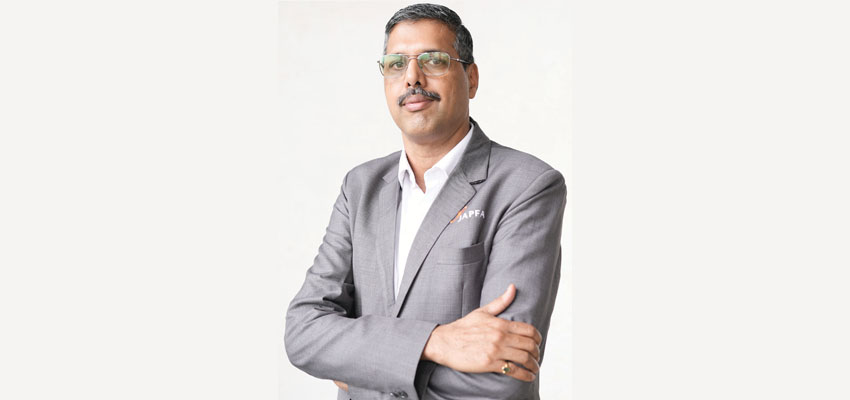
Numbers and balance sheets may intimidate some, but for Vidyasagar Appukuttan—who has spent more than three decades in the world of finance—they are not just rows on a spreadsheet, they are stories of impact, growth and possibility. As Director and Financial Controller of Japfa Comfeed India Pvt. Ltd., Vidyasagar has seen how money, when managed with discipline and foresight, can shape lives and organisations. Time and experience have humbled him, and being around money, he says, teaches you perspective more than power. In conversation with Corporate Citizen, Vidyasagar reflects on his journey, the financial trends that excite him, the advice that has stayed with him, and his evolving relationship with money
Corporate Citizen: Can you tell our readers a bit about yourself?
Vidyasagar Appukuttan: I believe in steady evolution. And, I am glad that this growth is guided by curiosity and a willingness to explore. Though my roots are in Kerala, as I was born and brought up in the lovely city of Pune, I proudly call myself a true Punekar. Professionally, I am a Cost Accountant and a member of The Institute of Cost Accountants of India. I have been in this field for over three decades now. Over the years, I’ve had the privilege of working across diverse industry verticals. I began my journey in the software industry, then moved on to capital equipment, followed by a stint in the pharmaceutical sector. I also spent a considerable time in the auto ancillary industry. After this wide-ranging journey, I shifted to the sunrise agro based industry and here I am now working as the Director and Financial Controller at Japfa Comfeed India Pvt. Ltd., a multinational company into industrial agriculture and known for its mission of providing quality affordable protein to the emerging population in Asia.
CC: It is said that the place you are born and raised in, shapes you into a better person. So how would you say that Pune has helped you become a better financial leader?
Pune proudly calls itself the Oxford of the East, and for good reasons. The city’s landscape is dotted with institutes, colleges and universities, whose quality of education is second to none. Over the years, it has produced distinguished scholars who’ve helped to shape the country in meaningful ways. In finance specifically, many of the nation’s most respected chartered accountants hail from here. That kind of intellectual ecosystem gives you a competitive edge, a real leverage in the corporate world. You’re constantly surrounded by some of the sharpest minds, and that environment pushes you to raise your own standards. It makes you want to excel. That’s exactly how Pune has shaped me as a financial leader.
CC: What made you choose this field?
I’ve always had an affinity for numbers, Mathematics in particular. I was good at it, too. When I chose commerce for my higher studies, numbers still had their pull on me, but now they came with a new companion - Statistics. It felt like a dream, learning more about the subject I genuinely loved. As I dug deeper, I realised that at the heart of it all was money or rather, finance. And, I knew money was worth nothing unless you understand its value. That’s what set me on a quest to grasp the bigger picture, how every function within an organisation connects and contributes. I couldn’t pursue my CA due to economic constraints, but I found an equally exciting path in Cost and Works Accounting, a field that marries management with cost control, and demands the same precision, insight and discipline, I’ve always admired in finance.
"Money has humbled me. Early in your career, you chase it — promotions, increments, the bigger number on the payslip. But over time, you realise it’s a tool, not the goal. It can create security, opportunity, even freedom, but it doesn’t define your worth "
-Vidyasagar Appukuttan
CC: After 40 years, how do you view money — professionally and personally?

The main aim of any organisation is to make profits. And, profit contrary to popular sentiment, is not a bad word. When people say that the sole objective of a corporation is to make money, they often overlook the fact that profits are also reinvested, not only into the business, but also into the broader community.
Today, with mandatory Corporate Social Responsibility (CSR) obligations, sustainability reporting, and other social commitments, companies are spending resources in ways that uplift their surroundings. This creates a cycle, as the community grows, the industry grows and as the industry prospers the community thrives. It is, in every sense, an all-encompassing ecosystem.
On a personal level, my relationship with money is more measured. As a finance professional by training, I understand its importance, but I do not chase it, rather I chase my dreams or purpose. Of course, we all have objectives, but beneath everything, I am content. In my younger years, like many, I wanted to do more, own more and experience more. I also grew up in an era when India often faced shortages and scarcity—that taught us to be frugal, to preserve resources, and to avoid waste, whether of money, food or opportunity.
Purpose over money: Over time, abundance replaced scarcity, and with it came a shift in priorities. Beyond a certain point, the question is no longer “How much can I earn?” but “How much can I contribute?” Today, what matters most to me is the impact I can make, how I can help others grow, both professionally and personally.
As the Head of Finance and a Director, my focus is not just on balance sheets but on people. No one, especially members of Gen Z, joins an organisation expecting to spend a lifetime there. Their attention spans are shorter, and their aspirations broader. My role is to create opportunities, to give them challenges that stretch their capabilities, to equip them for a future that may take them far beyond our walls.
For me, money has moved far down the ladder of life’s priorities. What keeps me going today is not profit alone, but the positive change I can help bring into the lives of those I work with.
CC: What’s the best piece of financial advice you’ve ever received?
Very early in life, I received a piece of advice that has stayed with me. I was told "Live within your limits when it came to both time and money, and never take your income for granted". It was simple, but profound. That wisdom was followed by another reminder - things won’t always work in your favour. But, that’s not a reason to give up. Instead, you learn from setbacks, adapt, and always have a Plan B ready. Those principles have shaped not just my approach to finances, but my entire outlook on life.
"For me, money has moved far down the ladder of life’s priorities. What keeps me going today is not profit alone, but the positive change I can help bring into the lives of those I work with"
CC: By the looks of it, I feel that you have learned the art of stillness by being in the financial world. Have you mastered it?
Maybe not stillness but definitely balance. In volatile industries like the one I am working in now, commodity prices swing with the weather. You need a method in that madness. Cash management is crucial. Businesses don’t fail because they’re unprofitable, they fail because they run out of cash. The same applies to personal finance.
CC: I am sure you must have seen a lot of highs. Tell us about the lowest point in your life and what are your learnings from that?
This was in the ’90s, when I was handling treasury for a company. My job was to ensure we always had enough funds, coordinate with banks for loans, and oversee large outgoing payments, amongst other responsibilities. In India, festivals are a time that bring people together, and Diwali is the festival everyone looks forward to. That year, we had promised bonuses to our employees.
Just days before Diwali, the bank I had been coordinating with refused to release the funds. It was the festival of lights, and I couldn’t bear the thought of our employees celebrating in the dark. So, I pulled a few strings, reached out to other banks, and somehow managed to secure the funds in time.
It was a tense moment, but it taught me an invaluable lesson – life can be hard, but the key is not to dwell on the problem, it’s to work relentlessly on the solution. Never take anything for granted, and always have a Plan B. To this day, I maintain multiple banking relationships and backup credit lines, so that no festival, no commitment, and no promise ever goes unfulfilled.
CC: You were the youngest P&L leader in one of the organisations you worked for. How was that experience?
Yes, it was in one of the earliest organisations I worked for. Honestly, it wasn’t intimidating at all. On the contrary, I felt incredibly welcomed, which took away any pressure I might have felt. My colleagues, business heads, managing directors, and even the group CFOs, made me feel like an integral part of the business management team.
They were all extremely supportive. In finance, you don’t just crunch numbers, you need to understand the business model and how all the pieces connect. They often looked to me for the financial perspective, and I, in turn, looked to them to understand their vision, why they wanted to pursue a certain direction and what challenges they faced especially in sales or production. It became a true exchange of expertise — I offered clarity through numbers, they offered insight into strategy and operations. In the end, it was a perfect balance, a genuine win-win.
CC: You are a financial pundit, why don’t you guide us on how much should one ideally save from their income?
Be it professionally or at personal level, financial planning has become a very important discipline. In our own organisation, our treasury policy is shaped by one key reality knowing our cash flows are not always stable. They can fluctuate or even disappear, depending on unpredictable factors like commodity prices.
That’s why we maintain a reserve equivalent to six months of expenses. The logic is simple, if we need to approach a bank, the entire process - from negotiation, to getting an offer, to securing the sanction letter, and even obtaining court approvals, can easily take that long. That’s the buffer we build in.
My advice to young professionals is the same – keep at least six months’ worth of cash as an emergency fund. Life is unpredictable. A sudden outbreak, an unexpected expense or a personal crisis, can come without warning. With six months in reserve, you give yourself a window to consider your Plan B or even Plan C, without being forced into hasty, costly decisions. You don’t necessarily need to map out exactly how much cash you’ll have five years from now. Longterm plans are good in theory but often impossible to execute with precision. What matters is that, at any given point, you can cover the next six months. That’s your safety net.
CC: You’ve spoken about your role as a leader who should ‘produce more leaders’. How does that look in practice?
For me, it happens in two ways. First, through servant leadership – being willing to serve the team, to remove obstacles, and to ensure they have what they need to succeed. Second, by giving them challenges. Not the kind where you throw them over the wall and walk away, but challenges where I’m right there with them, mentoring, guiding, helping them think differently. It’s not about handing people a job, it’s about handing them an opportunity to grow. In my current organisation, I take pride in knowing that everyone who has worked with me, leaves as a stronger version of themselves. They grow not just professionally, but personally as well. Many of them now lead finance functions independently, and it gives me immense joy to see them succeed and thrive in their own journeys.
CC: You’ve worked in finance for decades. Has your relationship with money changed over time?
Completely. Money has humbled me. Early in your career, you chase it — promotions, increments, the bigger number on the payslip. But, over time you realise it’s a tool not the goal. It can create security, opportunity, even freedom, but it doesn’t define your worth. That shift changes how you lead. You stop measuring everything in terms of profit alone and start measuring in terms of people — their growth, their confidence and their ability to lead without you in the room.
CC: What is the financial industry expecting from fresh graduates?

The financial industry operates differently from the broader corporate world, and freshers need to be ready for that reality. From what I’ve observed, institutes need far more industry–academia collaboration so that students get real exposure to how the industry functions. Take accounting, for instance - in college, students are taught the fundamentals like debits, credits, double-entry bookkeeping, and others. But, when they enter an organisation that uses an Enterprise Resource Planning (ERP) systems—they don’t actually see those entries being posted because the system handles them automatically. However, there is a way to view and understand how those entries are generated, and students should be introduced to these ERP basics before they join the workforce.
Bridging the gap: Another gap I see is in understanding how different functions within a business are interconnected. Most institutes teach finance, marketing, HR, operations, and so on as separate subjects. But, in the real world, a decision in one department can create challenges in another and ultimately, all of this flows into the company’s balance sheet or P&L statement. If institutes could bring in more examples, more case studies, and more cross-functional teachings, students would enter the industry not just with theoretical knowledge, but with a practical sense of how businesses truly operate. That would make them far more effective from day one.