Cutting-edge Technologies Powered by AI

As technology is taking centre stage in shaping India’s future, it is also leading to groundbreaking innovations and next-generation solutions. Corporate Citizen brings you some of trending tech that were showcased at the recent India Mobile Congress 2025 exhibition, held at Yashobhoomi (India International Convention and Expo Centre), New Delhi. A platform where digital future came alive
Annapurti GrainATMs promoting digital inclusion
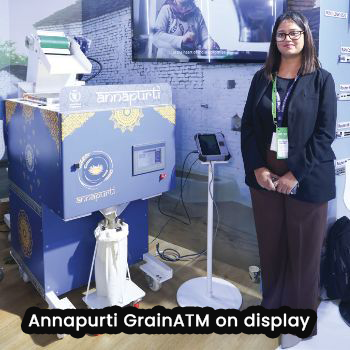
The Annapurti- GrainATM project, displayed at IMC 2025, is a Corporate Social Responsibility (CSR) initiative that involves the deployment of 5G-enabled, automated "Grain ATMs" in India, developed in partnership with the United Nations World Food Programme (WFP), under the guidance of Department of Food and Public Distribution. Ericsson is the key partner in providing the 5G connectivity and technology that enables the system.
This initiative, Natasha Panwar, exhibitor representative, UN World Food Programme informed that it aims to modernise India's Public Distribution System (PDS) and enhance food security through technology.
On the key features and objectives, Natasha informed that the "Annapurti" machine functions like a typical ATM but dispenses multiple food grains (e.g., rice, wheat) instead of cash. “These machines provide round-the-clock access to food entitlements, dispensing 25 to 30 kilograms of grains in just 30-40 seconds. Beneficiaries use Aadhaar authentication to access their full food ration, ensuring transparency.”
A significant improvement over manual weighing processes, the Annapurti machine has a capacity of holding 500 kilograms, with the standalone machine having a capacity of 2500 kilograms. The core intelligence of the machine uses a 5G connection for instant, secure, and reliable data transmission and real-time synchronisation with state Point of Sale (POS) systems. “The initiative supports the Government of India's ‘One Nation, One Ration Card’ scheme by allowing any valid ration cardholder from any state to access their entitlements,” said Natasha. The project has deployed 29 (3 standalones and 26 Annapurti machines) units at fair price shops in seven states in India, with future plans to scale up the initiative.
The Annapurti project demonstrates how 5G technology can be leveraged for social impact, promoting digital inclusion and tackling logistical challenges in public welfare systems.
Spot—the agile mobile robot dog
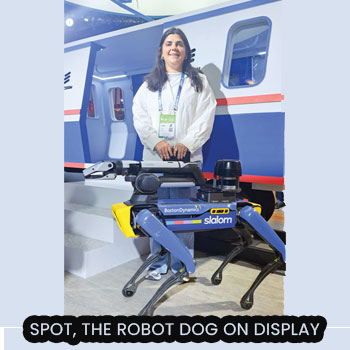
Spot is an agile, four-legged robot dog developed by Boston Dynamics for industrial, public safety and research applications. It can navigate difficult terrain, climb stairs, avoid obstacles, and be equipped with various sensors; and a robotic arm for specific tasks like site inspections, hazardous area exploration and data collection.
Displayed and demonstrated at the IMC 2025 exhibition, Ericsson pavilion, exhibitor representative from Slalom Consulting LLC, Jenna while talking about the robot dog said, “We are here to partner with Ericsson and Hitachi, and to demonstrate automated inspections of any industrial facilities. We are currently working with Spot, the Boston Dynamics robot dog, to conduct safe and secure inspections using visual inspections, cameras, sensors, any kind of chemical sensors you need to add.”
Informing about the robot dog, Jenna said that its made to walk around at the Boston Dynamics production facility in the US, checking if any defects are on the products— the bolts are tightened, loose wires, scratches, dents, anything of that nature. They are all of these cases for robot inspection. The robot dog is powered by Ericsson 5G network; it allows 5G sim card to be used on the robot or any devices you want to send the data to.
The Spot robot can conduct safe inspection. “It’s primarily been actively used in the US and UK. Many factories have implemented these robot forms, to be able to collect data safely. In India right now, the Boston Dynamics brand is not available, but there are other brands with similar four legged unitary robots,” said Jenna.
Boston Dynamics are the robot manufacturers, who create the hardware. Slalom is a consulting company, who create the software. “So, any custom inspection clients would need, we create all of the capabilities to get the data from the dog robot into their systems; and all of the process change management, and all other organisational consulting that would go along with,” informed Jenna.
“The robot dog if it has a fall, can pick itself up from a fallen state—so no humans need to be in the facility where the robot is operating. It is able to self-pickup and autocorrect, and its limbs rotate 180 degrees,” said Jenna. She further informed that there are two rails alongside the robot, which allows to add new payloads. One can purchase new cameras, sensors, or costumed payloads to be able to acquire any data one wants.
Spot is equipped with five stereo pairs of depth cameras that allow it to perceive its surroundings in 3D and dynamically navigate around objects like pipes, pallets and furniture. Its four-legged design with 12 motors (three in each leg) enables it to walk, trot, climb stairs, and traverse rough, uneven terrain with high stability.
Intelligent robots for diverse applications
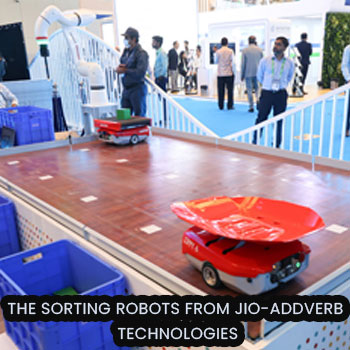
Jio and its subsidiary Addverb Technologies have developed a new robot set—displayed at the Jio pavilion in IMC 2025—which leverages Jio's AI platform and 5G services for advanced autonomous tasks. This project is a major step into the robotics market, using the combined power of Jio's telecommunications infrastructure and Addverb's manufacturing expertise to create intelligent robots for diverse applications such as warehouse logistics, healthcare and defence.
Reliance, through Jio, is strategically investing in Addverb Technologies, a company that has already deployed various robotic solutions. Manager - Solution Sales, Addverb Technologies, Vaibhav Singh, informed, “As part of industrial and warehouse automation, the robots will be deployed in logistics and supply chains to automate tasks. These two robots that we have showcased here are the sorting robots. The major work they do is sorting, for the eCommerce industry.” He said that these robots have been deployed recently for Lenskart.
The robots will feature advanced AI, including Visual and Language Action (VLA) technology, allowing them to make decisions and adapt to their environment. They can learn from data and environment to perform a wider range of tasks. The robots are designed to handle dull, dirty and dangerous (3D) jobs, improving efficiency and safety in various industries.
6G Sensing Fusion: Enhancing Security, Surveillance and Safety
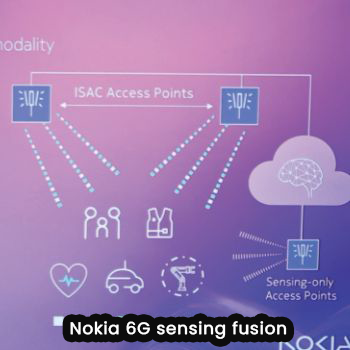
Nokia 6G Sensing Fusion is a technology that combines the sensing capabilities inherent in 6G radio access networks (RAN) with data from other sensors (such as cameras and accelerometers) to create comprehensive, real-time situational awareness and detailed digital representations (digital twins) of the physical world.
Representative from Mobile Divisions Network, Nokia, Rohith Kaushik Ananth, informed that the presentation of 6G Sensing Fusion at the Nokia pavilion, IMC 2025, is a concept demonstration of network as a sensor. “Here we are trying to show how the network based sensing is available. How does it integrate with a conventional camera based sensors which are already deployed? We are fusing the camera with vision analytics and that we are integrating with the network as a sensor. With both together we are able to identify movement of a person across camera and record as a sensor,” he said.
Nokia Bell Labs is pioneering the idea that the 6G network will not just connect sensors, but act as a sensor itself. By bouncing radio signals off objects, the network can determine their presence, shape, location, speed and potentially even material properties. This effectively gives the network a "sixth sense" that extends human awareness beyond immediate surroundings.
The sensing is being worked upon and studied upon, in the standardisation body which is EGPP. “The capability currently is proprietary which we have demonstrated, but this will be standardised over the years,” said Rohith.
The uses cases, Rohith said, “Will be in a facility—let’s say there is a fire incidence and then there is smoke and fire; conventional cameras may not be able to detect what is going on, and in that case the radio sensing which can work in low visibility conditions could be used to sense how many people are actually in a place.”
The applications for 6G Sensing Fusion are in security and surveillance, industrial safety, transportation safety, healthcare and wellbeing, immersive experiences, and presence and movement of people. Artificial intelligence and machine learning play a central role in processing and understanding this massive amount of data to derive actionable insights.
“Maybe in three to four years you will see the initial standards coming out and then it is about how the use cases evolve, which will determine when it will be commercialised,” said Rohith. Nokia as a OEM is an active player in this standardisation of all these technologies.
Interactive display for smart learning
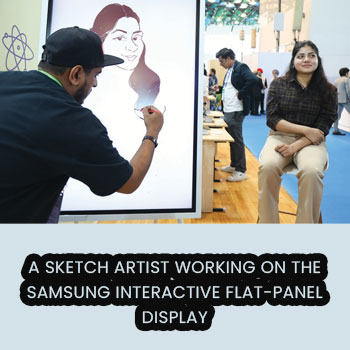
The Samsung WMR series of interactive flat-panel displays, presented at IMC 2025, such as the Samsung Flip 2 WM55R or the Samsung Flip Pro WM75B, are designed to replace traditional whiteboards with an interactive digital version for business and education.
The displays offer a smooth and natural writing experience with a variety of colours, styles and widths. You can use a passive stylus or your finger and erase with a palm swipe. Artists can use different paint brushes of different sizes and on basis of the hair thickness, and accordingly the strokes of paints also differ.
Exhibitor representative from Samsung India Electronics, Neeraj Aggarwal said, “This flip interactive flat panel display from Samsung, is having a finest touch, giving you feeling of pen-paper experience when you write on top of it. It also has a brush mode, wherein as an artist one can use the panel for their art works, as digital canvas.
Connectivity options include USB, HDMI, Wi-Fi and Bluetooth. “After a meeting or lesson, one can easily distribute recaps and notes to attendees by saving them as PDFs or images and sharing them via email or a USB stick. Experience pen-to-paper-like writing,” added Neeraj.
All models feature a 4K UHD resolution, which provides clear and captivating visuals in any room setting. The displays support multitouch, allowing several people to write on the screen simultaneously.
Future Extended Reality (XR) Vision
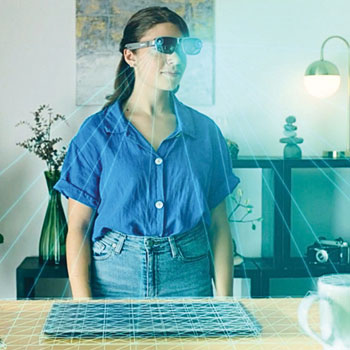
Qualcomm's Snapdragon Future XR Vision, centres on the idea that Extended Reality (XR) will be the next ubiquitous computing platform, eventually converging the functions of smartphones, AR glasses and VR headsets, into a single, sleek, and AI-powered wearable device.
“This vision is supported by foundational technologies in connectivity, AI and processing, aimed at making XR experiences seamless, immersive, and part of everyday life,” said a representative from Qualcomm, at the IMC 2025 Exhibition.
The goal of this Future XR Vision device is to replace multiple screens with one lightweight, all-day-wearable XR device. This concept uses on-device processing, 5G/Wi-Fi 7 connectivity, and edge cloud processing. The aim is to enable high-fidelity, low-latency experiences from almost anywhere without cords or a PC. Future XR will integrate on-device and cloud-based AI. This will provide contextual awareness, natural interactions, and intelligent assistance.
Local to Global
This use case Swadeshi: Local to Global prototype displayed at IMC 2025 exhibition—from Vodafone Idea perspective is a demonstration of what technology can do and how it can better lives for certain set of consumers. Nitin Jain , EVP - Content, Partnerships & Monetisation, Vodafone Idea Ltd., tells more about this AI platform
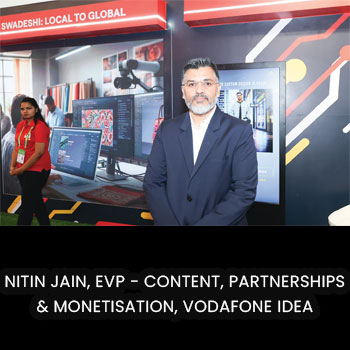
Here we basically picked up the cause of local artisans. We all know there are lot of handicrafts in India—there are around 3000 recognised crafts from different states of India and there are over 70 million citizens who are actually employed in creating and selling these crafts.
Now the challenge that these artisans have today is, over a period of time the consumption, purchase of any product or material of these crafts is actually going down. These local artisans have been struggling to compete with the large brands, particularly from the international brands which have entered the market over the last couple of years. One key issue there is, the gap that they have is basically the lack of design inputs in particular. They cannot bring professional designers on board, as they can’t afford. What this technology is doing is, it is basically filling in for that gap.
Swadeshi is an AI platform, wherein the AI is generating the design on the basis of customers inputs. What we have displayed here is a very basic prototype to demonstrate that, but in reality it can actually scan your body, it can look at what your likes and dislikes are, what is you taste—ask for couple of inputs and on basis of those inputs it can generate a design. It can continue to give you multiple designs, till such time there is one that you do not like. And, over a period of time, it can become intelligent to give you very accurate outcome that you would like in one go. Now it doesn’t stop here—once you as a customer liked a design, it will be made using some of these handicrafts and fabrics—these designs are no less than any global brands.
The moment you have liked a design as a customer, that design goes to the artisan as an input that this is what the customer wants, along with the video manual for how to create that design - where to cut the fabric, what kind of threads to use, how to stitch it—every single details go to the artisan. And, for every design that would happen, it will make their jobs easier to actually create that design without investing any effort or getting professional advices on it.
How artisans will get connected to the platform? This is a prototype platform, and its about supply and demand coming together. And, that’s the role we will play to bring this demand and supply together. But, not alone—we will definitely need some of the large organisations, who are in the apparel business on the fashion side, to take it to the market, And, we would basically do a job of getting the artisans connected to that platform.