Breakthroughs to Better Health
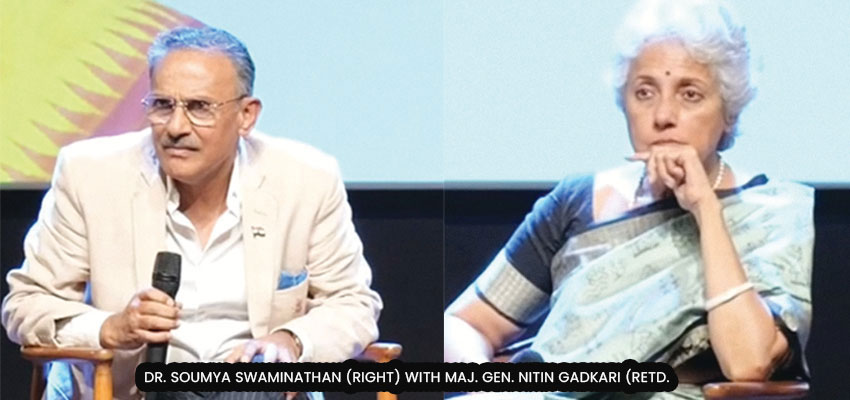
At the inaugural PIC-Wipro Annual Lecture in Pune, global health leader Dr. Soumya Swaminathan, former chief scientist of the World Health Organisation (WHO) and Chairperson of the M.S. Swaminathan Research Foundation (MSSRF), captivated the audience with a powerful address and a discussion moderated by Major General Nitin Gadkari (Retd.), Director, Pune International Centre. Drawing on her decades of experience in research, public health, and senior policy roles, she explored the critical theme of ‘Breakthroughs to Better Health: Making Disruptive Technologies Work for India’. Corporate Citizen brings you the key excerpts from her illuminating talk
Equitable medical care for all
Dr. Soumya Swaminathan: Yes, I firmly believe we can and we must—health is one of the most fundamental human rights enshrined in our Constitution. The only way to achieve true equity in healthcare is by strengthening public health systems. If we leave healthcare entirely to market forces or to the private sector, it inevitably leaves the poorest behind. There’s nothing wrong with private health services; they play a vital role. But, when it comes to universal access and affordability, the government must take stewardship
The public sector needs to lead with clear governance, data-driven planning, and accountability. The government should coordinate a network in which both private and not-for-profit entities can participate under regulated frameworks. It must ensure that quality care reaches the poorest, not just those who can pay. If we strengthen public systems, use private capacity intelligently, and invest in primary healthcare, India can indeed move closer to equitable medical care for all.
Achieving the SDG targets for 2030
It’s true, progress has been uneven. Roughly half of our states have reached or are close to achieving the SDG targets, while others lag significantly behind. So, it’s a glass-half-full story. The states that struggle, share common issues: malnutrition, poor access to health services, and lower levels of literacy amongst women. The solution lies in strengthening primary healthcare and ensuring
comprehensive maternal and child services. The National Health Mission and the ASHA programme, with over a million community health workers, have transformed outcomes in many areas, but we must go deeper into the regions still left behind. Much of this is linked to nutrition, sanitation and women empowerment. Early marriage and teenage pregnancies remain major contributors to poor outcomes. Anaemia affects more than half of Indian women. We must tackle this through a combination of better diets, clean water, sanitation, and improved quality in social schemes like the Public Distribution System and school or anganwadi meals. If we invest a little more and deliver food that is not just calorie-rich but nutrient-dense, we will see dramatic changes in maternal and child health indicators.
Philanthropy struggles to find motivated researchers
That’s a valid concern. Philanthropies often want to fund meaningful research, but the academic culture in many medical colleges does not nurture curiosity or inquiry. This starts early—in schools and universities where students are taught to memorise, not to explore. In many Western countries, children are introduced to research and experimentation from a young age. They are encouraged to ask questions, collect evidence and think critically
At our foundation, we run a programme called 'Every child a scientist' for governmentschool students from classes 6 to 8. They spend two weeks with scientists, conduct experiments, and observe biodiversity. It’s transformative, even in that short span. We need such exposure across India. I myself grew up in a research institute, surrounded by PhD students and scientists. That environment shaped my curiosity early on. Unless we integrate that culture of exploration into education, philanthropy will continue to struggle to find motivated researchers.
Growing distrust in the medical system
Trust is essential in healthcare, and yes, there are reasons it has eroded in some quarters. Yet globally and in India, surveys show that doctors and scientists still rank amongst the most trusted professions. The problem arises when patients sense that profit is prioritised over their well-being. To restore faith, we need transparent governance and strong regulatory frameworks.
Learnings from Covid pandemic
Covid pandemic should have been a wakeup call for humanity. For a while, it seemed people were re-evaluating their lifestyles, valuing health, family and community, more deeply. But, in reality we quickly reverted to old habits. The pandemic did remind us of our interconnectedness and the need for global solidarity; something we must apply now to climate change, which poses an even greater threat. Unlike Covid, there’s no vaccine for the climate crisis; the solutions demand collective action, sacrifice and political will.
"Technology alone cannot heal—it must work hand-in-hand with equity, empathy and ethics. India has the scientific talent, digital infrastructure and youthful energy, to lead global health innovation"
Integrating traditional and modern medicine

India’s strength lies in its diversity of knowledge. We have codified systems like Ayurveda, Siddha and Unani, as well as thousands of community-based practices where traditional healers use local herbs, roots and minerals. Ayurveda, in particular, is now being studied more systematically through the Ministry of Ayush. We’re beginning to evaluate these treatments scientifically, though we still have some distance to cover compared to China’s success in integrating traditional and modern medicine.
For preventive and chronic diseases, there is enormous potential in Ayurveda and related systems. But, our non-codified folk medicine used by tribal and rural healers, is a treasure trove waiting to be explored. Documenting, testing and validating these local remedies could lead to discoveries that serve both science and culture. The goal should not be competition between systems but collaboration that benefits patients.
Harnessing technology in healthcare
Resistance to change is human nature, particularly in professions where confidence in one’s expertise is high. Many doctors are comfortable with traditional methods and hesitant to trust automated systems. Part of the problem is the lack of rigorous clinical studies, demonstrating technology’s superiority in specific contexts. Once strong evidence emerges and regulations mandate best practices, adoption will increase naturally.
We must treat technology like any new medical intervention—evaluate it, prove its benefit, and then integrate it through guidelines and continuing education. Younger doctors will likely embrace it more easily, but all medical professionals need lifelong learning. Our medical councils should make continuous education and digital literacy essential. The key is not to replace human judgment but to augment it with tools that improve accuracy and efficiency.
Delivering affordability and advancement
This is a growing dilemma. Hospitals require capital to innovate and expand, yet healthcare cannot be treated purely as an industry. We are already seeing tertiary hospitals designed around high returns, accessible only to a small, affluent section. For the majority, such care is out of reach, forcing families into debt or asset sales. The only sustainable solution is a robust public health system providing quality care at every level.
However, innovation thrives when the public and private sectors collaborate. Private investment in R&D, such as during the Covid-19 vaccine race, was essential. Indian firms like Serum Institute of India, Cadila Pharmaceuticals, and Bharat Biotech took bold risks. The government’s role is to ensure this innovation benefits all, setting fair-profit boundaries and preventing exploitation.
When governance, public funding, and private creativity align, we can deliver both affordability and advancement.
Humility must guide every scientific endeavour we undertake
If there’s one message I’d emphasise, it’s that technology alone cannot heal—it must work hand-in-hand with equity, empathy and ethics. India has the scientific talent, digital infrastructure and youthful energy, to lead global health innovation. But, we must ensure that every new idea or device serves our most vulnerable citizens first. Public systems must be strong, transparent and data-driven; and private innovation must align with national priorities.
Disruptive technologies are powerful only when they disrupt inequality. We need systems that learn and adapt continuously, guided by evidence and compassion. Science should always stay rooted in society—listening, learning and giving back. Whenever I visit villages and speak with farmers, tribals or fisherfolk, I’m reminded that wisdom and kindness exist even amid hardship—humility must guide every scientific endeavour we undertake.