The Textbook's First Page
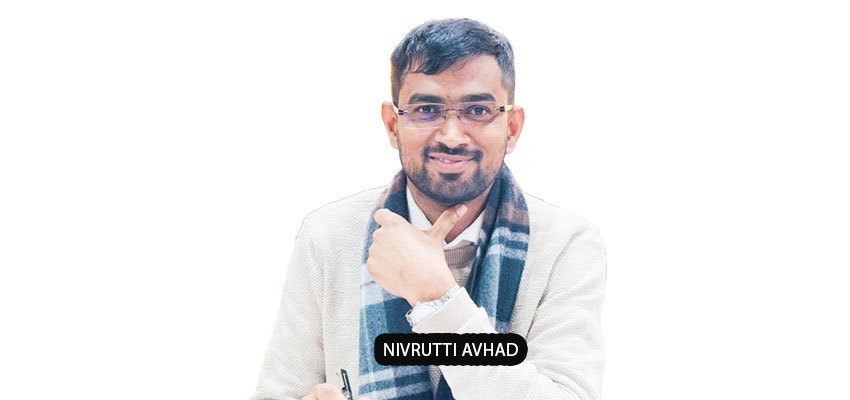
In Rajasthan’s Dholpur district, IAS officer Nivrutti Avhad has turned the forgotten first page of a textbook into a starting point for civic pride. His quiet 'Chandrajyoti Abhiyan' is helping children live the Constitution of India and communities reclaim neglected spaces for educational growth
"Development cannot always be gauged through cosmetic changes, and infrastructure like flyovers and bridges alone. It is also about what happens at the grassroots, the base must be firm and strong"
The first page of a school textbook rarely means much, children scrawl their names there, perhaps doodle a cricket bat or a flower, and quickly move to the actual lessons. In India, every textbook begins with the Preamble to the Constitution—a page often skipped in the rush to complete the syllabus. But in Rajasthan’s Dholpur district, that very page has become the centre of a remarkable movement ‘Chandrajyoti Abhiyan’, which later flourished into bigger education initiatives.
The credit goes to IAS officer Nivrutti Avhad, who decided that the words printed on the opening page—the Preamble of the Indian Constitution—deserved far more attention than they were getting. For him, the Preamble was not just an ornament, it was a guiding light. And, it pained him to see children flip past it without even reading.
Living the Preamble
When he took charge as CEO of the Zilla Parishad in late 2024, he saw Dholpur for what it was: one of India’s most backward districts, labelled aspirational but starved of opportunity. Yet, he also saw possibility in every cracked wall and neglected classroom. What he began was not another government scheme but a very human effort to remind children—and through them, their communities—of the values that hold the nation together.
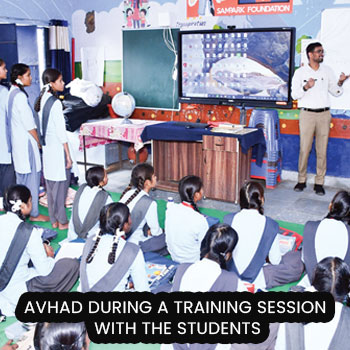
He called it ‘Kitab Ka Pehla Panna’ — the first page of the book initiative as the first drive under 'Chandrajyoti Abhiyan'. The idea was simple: bring the Preamble to life. Schools began starting their day with its recital. Debates, quizzes and poster making, soon followed. Teachers who once treated civics as a dry subject found new ways to ask a question: What does equality mean in your village?
Children, for their part, took to the exercise with enthusiasm that surprised even their parents. Many had never spoken up in class before; now they were debating what liberty meant or how secularism applied to their everyday lives. “Earlier, democracy was something we only read in books. Now we practise it. The practice of democracy took a more concrete shape through Bal Sansad sessions — Children’s Parliament initiative wherein students campaigned, voted, and formed cabinets. Ministers of health, sanitation and education, emerged in these mock assemblies, echoing the structures of government. For the first time, ten-year-olds were learning the give and take of leadership not as a lesson, but as lived experience,” Avhad recalls.
For Avhad, this was the real victory. “When a child questions what liberty means, they are already more empowered than many adults,” he says with quiet conviction. His own life—a mechanical engineer who worked in a steel plant in Odisha before clearing the UPSC after multiple attempts— gives him credibility when he speaks of perseverance and self-belief.
Empowering digitally
His contribution didn’t end with classrooms. On his frequent field visits, he kept noticing abandoned government buildings — panchayat halls with peeling paint, schools left to crumble, offices that had outlived their purpose. “Why should those assets lie in disuse and shambles when they could be the beating heart of a community? The mentality is — it is not our property so why should we bother, whereas it should the exact opposite belief,” Avhad added.
The best way forward was Digital Samvidhan Ghars under Chandrajyoti Abhiyan wherein old halls were cleaned up, repaired, and equipped with books, computers, solar powered lights and even smart TVs. They became vibrant learning spaces—civic libraries that served not just children but entire villages. In the evenings, adults gathered for Ratri Chaupal discussions (community meetings held at rural areas). Women’s self-help groups began to meet there. Girls often left without safe public spaces, found a place to study and participate—a plan that worked like it was chalked at the initial stages. So, the Chandrajyoti Abhiyan went beyond education.
Building sanctuaries of hope
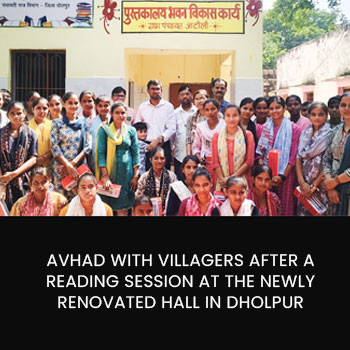
The symbolism mattered as much as the function. A locked and neglected building reopening as a hub of learning sent a clear message — something long ignored could be restored, just as a child’s faith in education could be reignited. “We didn’t just build libraries, we built sanctuaries of hope. In the whole district, I have aimed to have 100 libraries by the end of the year,” Avhad says.
Of course, not everyone believed at first. Villagers, used to broken promises, shrugged it off with the familiar phrase Kachu nahin hoga (nothing will happen). Sarpanches hesitated to part with land or funds. But, Avhad chose patience over pressure. By showing small, visible changes, and inviting local contributions, he built trust step by step. Committees were formed so that responsibility rested with the community. Soon, cynicism gave way to pride as people saw their children leading debates and their old buildings buzzing with life again.
The initiative reached 350 schools, impacting over 50,000 students. Through Bal Sansad sessions, students engaged with democratic principles. Morning assemblies featured children reciting the Preamble, while teacher trainings aligned with NEP 2020, helped integrate constitutional ideals into lessons via debates, quizzes and role-plays.
"Earlier, democracy was something we only read in books. Now we practise it. The practice of democracy took a more concrete shape through Bal Sansad sessions"
One classroom, one community
Embedding sustainability from the outset, the Chandrajyoti Abhiyan has built its work on community ownership and institutional strength, ensuring the initiative will thrive long after its founders have moved on. In Dholpur, the first page of the textbook is no longer an afterthought, it is a living promise. And, in this corner of Rajasthan, that promise is being fulfilled, one classroom, one community, and one citizen at a time.
It is tempting to reduce all this to numbers. But, the true measure of success lies in something harder to quantify, the transformation of attitude. Avhad shares, “Children who never raised their voice are now asking about justice and fraternity. Parents who once kept their distance from schools are now attending civic sessions. Teachers who once rushed past the Preamble now use it as a springboard for discussion. This is not a top-down campaign dictated by orders from Jaipur or Delhi. It is a movement owned by the people of Dholpur. It’s money from the community being invested for the community.”
Avhad himself remains understated about it all. “Development cannot always be gauged through cosmetic changes, and infrastructure like flyovers and bridges alone. It is also about what happens at the grassroots, the base must be firm and strong. I strongly believe in that.”
To him, the sight of a girl confidently chairing a Bal Sansad, or a group of children reciting the Preamble with conviction, is reward enough. The revolution, he insists, is not his alone but belongs to every teacher, student and parent, who chose to believe in the first page.
In Dholpur, a district that once seemed invisible, the first page of a textbook has become the first step towards change. And, it began with a simple, almost childlike question from an IAS officer who refused to ignore what others skipped over: Why don’t we read the first page first?