The Quiet PHILANTHROPISTS
From a farmer’s simple hospitality in a remote village to a judge’s lifelong support for struggling students, and from modest scientists who turned away from American dreams to serve India—the spirit of silent charity lives on in countless unsung Indians, quietly strengthening the moral fabric of our nation
When I look back down the long corridor of memory, one of the clearest images that emerges is of my grandfather’s courtyard in our native village. He was a farmer, and his life was simple, bound to the rhythms of the soil and the seasons. What defined him though was not merely his occupation; it was his generosity.
In those days, proper transport and infrastructure hardly existed. Travellers often arrived in our village exhausted, with their bullock carts dragging behind them, their animals weary. There were no guesthouses or inns to accommodate them. For most, the journey itself was a trial, and the need for food, shelter and rest, was constant. My grandfather never turned them away. His home was their refuge. He offered a warm meal, a place to sleep, and even cared for the animals that accompanied them.
Over the years , he institutionalised this habit, setting aside a substantial portion of his income to sustain it. He did this without fanfare or expectation of recognition. When I once asked him why he bore this responsibility without complaint, his answer was simple, “It is our Dharma, our culture, our religion. What else is life for, if not to help.”
That was my first lesson in quiet philanthropy; the kind that neither seeks nor desires publicity, but flows as naturally as breathing.
My father’s way
Years later, I saw the same spirit embodied in my father, though in a different form. My father served as a judge in Patna, where our government bungalow was large, complete with servant quarters. But, those quarters were never used for staff. Instead, they were filled with students from our village—young men who had come to Patna to pursue education, but could not afford to live on their own.
My father gave them free accommodation, meals from our kitchen, and perhaps most importantly, encouragement. He believed that education was the surest path out of poverty and the strongest foundation for self-respect. These boys, many of who were first-generation learners, were made to feel at home in our house.
Even after his retirement, my father’s life was dedicated to giving. A large portion of his pension went out in money orders to support students back home. Month after month, he would quietly send help to those who needed it most. The pattern was always the same— give silently, give consistently, give without expecting a return.
Continuing the thread
I cannot claim to have matched their scale of sacrifice, but the thread continues. Throughout my working life, and now after my retirement, I have set aside a part of my modest income to help those in need, particularly for education and medical treatment. My wife, too, has made it her mission to support old-age homes and orphanages. We do what we can, and like my father and grandfather before me, we do not announce it. In fact, this is the first time I am writing about it.
In sharing my family’s story, I want to place it in the wider canvas of India’s long, living tradition of giving of Daan (selfless giving).
The Indian ethos of Daan
Charity in India is not new, nor is it confined to the wealthy. The concept of Daan is embedded deeply in our culture and religion. From the earliest scriptures to the epic tales of the Ramayana and Mahabharata the virtues of generosity are extolled as pathways to spiritual growth.
We recall Karna, known as Maha Daani (the magnanimous donor), who gave away his divine armour and earrings to Lord Indra, even though it meant his own defeat was assured. Then there was Saint Dadhichi, who donated his very body, so that a weapon could be forged from his bones to protect the world from demons. King Bali, who once ruled the three worlds, surrendered everything to the Vamana avatar, the fifth incarnation of Lord Vishnu.
These are not just legends, they are moral archetypes that shaped how Indian society has viewed wealth and its purpose. Prosperity was never meant for hoarding; it was meant for sharing, for maintaining social balance, and for uplifting others.
Modern exemplars
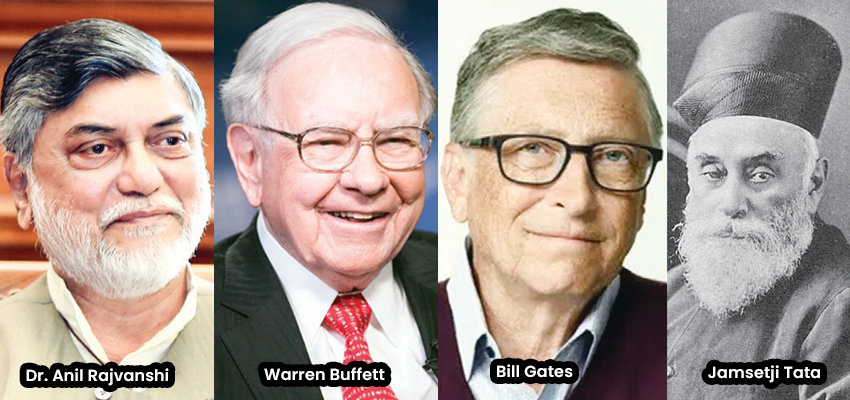
This ethos has found expression even in modern times. One figure I have personally known for over two decades is Dr. Anil Rajvanshi, a scientist whose life exemplifies selfless service. Born in Uttar Pradesh and educated at IIT Kanpur, he pursued his doctorate in Florida, and had a promising career in the United States. Offers from blue-chip companies, with high salaries and bright prospects, came his way.
However, Rajvanshi made a different choice. Married to Dr. Nandini Nimbkar, a Maharashtrian, he chose to return to India and settle in Phaltan, a small town near Satara, where his father-in-law was already engaged in charitable work. Since 1981, he has led the Nimbkar Agricultural Research Institute (NARI), dedicating his life to rural development and renewable energy solutions.
His projects have ranged from biomass-based cooking and lighting technologies to water innovations, and even electric rickshaws. He lived simply, drawing only a modest honorarium for his personal needs, ensuring that grants received for research were spent entirely on research, not personal enrichment.
For young Indians dazzled by the lure of H1B visas and high-paying jobs abroad, his life sends a clear message: greatness lies not in what you take from the world, but in what you give back to your motherland.
"Charity in India is not new, nor is it confined to the wealthy. The concept of Daan (selfless giving) is embedded deeply in our culture and religion"
The spirit of trusteeship
The moral logic behind philanthropy was articulated by Mahatma Gandhi in his concept of trusteeship. Wealth, Gandhi believed, does not belong solely to the individual who holds it, but to society at large. The rich are merely custodians, entrusted with using their resources for the benefit of all.
Globally, we see echoes of this philosophy in initiatives like the 'Giving Pledge' started by Bill Gates and Warren Buffett, which calls upon billionaires to donate most of their fortunes. In India, the Tata family set the benchmark. Jamsetji Tata was not only a pioneer industrialist but also one of the greatest philanthropists, creating trusts that continue to fund hospitals, universities and scientific institutions.
Yet, as important as large-scale philanthropy is, the true backbone of giving in India lies in the quiet, anonymous acts performed daily by ordinary people. Those who follow the dictum—do good and forget.
Beyond money—many faces of giving
Giving is not limited to wealth. One can give time, knowledge, compassion, and even just presence. A teacher who mentors a struggling student, a neighbour who helps care for an elderly couple, or a volunteer who plants trees for future generations are all philanthropists in their own right.
As Gautama Buddha said, “Thousands of candles can be lit from a single candle, and the life of the candle will not be shortened, happiness never decreases by being shared.”
The true meaning of life, perhaps, is to plant trees under whose shade you do not expect to sit.
When we give, we receive
There is also a paradox at the heart of giving: while it seems like we lose something when we part with our time, money or resources, in truth we gain. The donor is often as enriched as the recipient. Giving creates a cycle of joy. As Confucius, a Chinese philosopher once said, “He who wishes to secure the good of others has already secured his own.” This is the essence of Vasudhaiva Kutumbakam—the idea that the whole world is one family. When we give, we do not ask about caste, creed or nationality. The act itself is what matters.
The quiet revolution
As I think of my grandfather’s open doors, my father’s kitchen that fed young scholars, and my own modest attempts, I realise that philanthropy is not about size—it is about spirit. It is about believing that what we have is meant to be shared.
The quiet philanthropists—the farmers, the teachers, the retired professionals, the scientists who return to villages instead of staying in America—are the invisible threads that hold our society together. They do not make headlines, but they make a difference.
Winston Churchill once said, “We make a living by what we get, but we make a life by what we give.” That truth has resonated across generations in my family, and I believe it resonates across India as well.
The future of our country will not just be built by policies, technology, or GDP numbers. It will also be built by these quiet philanthropists who are ordinary people with extraordinary hearts, who remind us that the noblest wealth is the wealth we share.